
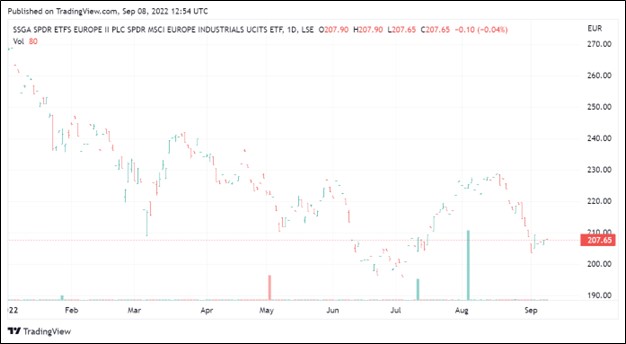
Image Shown: The SSGA ETFS Europe II PLC SPDR MSCI Europe Industrials UCITS ETF, listed in the UK, tracks large and mid-sized European industrial firms. Shares of the ETF have fallen sharply year-to-date as recessionary fears across Europe have grown substantially in the wake of the Russian invasion of Ukraine in February 2022 and the related European energy crisis.
“Surging energy prices in Europe are decimating consumer spending power and forcing industrial companies to sharply scale back production. It is estimated that six in 10 British factories could fold as a result of the crisis, according to reports from Bloomberg.” — The Valuentum Team
By Callum Turcan
The European energy crisis continues to unfold, and we’ve been keeping our members updated on this huge story (link here). In the wake of the Russian (RSX) invasion of Ukraine in February 2022, the European Union (‘EU’) along with key Western allies (such as the US, UK, Canada, Japan, South Korea, and Australia) imposed punishing economic sanctions on Russia to hinder its efforts in Ukraine and deter other nations from pursuing imperialistic land grabs.
Europe is on the brink
Over 70000 people came out in support of Russia in Prague and are forcing the Govt to resign for supporting Ukraine pic.twitter.com/lwMAjkBM2U
— Mahesh 🇮🇳 (@Mahesh10816) September 3, 2022
Tweet: Europeans are having second thoughts about the sacrifices made in support of Ukraine in the wake of soaring energy prices.
Russia retaliated by limiting the flow of various energy products to nations that imposed those sanctions. In particular, energy flows from Russia to member nations within the EU were curtailed aggressively, with an eye towards France, Italy, and Germany along with Poland and the Baltic states (Latvia, Lithuania, and Estonia). Natural gas, crude oil, and petroleum product exports from Russia to EU member nations have tanked this year.
It could be a “cold” winter in Europe, and perhaps not only figuratively speaking.
Background on the Crisis
Before this crisis began to unfold, Russian natural gas exports to EU member nations were an essential part of how the EU met its energy needs according to the International Energy Agency (‘IEA’). In 2021, Russian natural gas exports to the EU represented roughly 45% of the EU’s total natural gas imports and around 40% of its total natural gas consumption. While the EU has some capacity to receive liquified natural gas (‘LNG’) imports via regassification facilities that can convert LNG to gaseous natural gas, replacing almost half of its annual natural gas imports is a monumental task.
Supplies of LNG were already tight before the crisis began to unfold. Data from BP plc’s (BP) 2022 Statistic Review of World Energy noted that China’s natural gas consumption grew by 11% per year from 2011-2021, and by around 5% annually during this period in the Hong Kong special administrative region (‘SAR’). Across the entire Asia-Pacific region, natural gas consumption grew by 4% per year from 2011-2021. This is significant as many Asian-Pacific economies meet their natural gas needs via LNG imports, and Europe is now effectively competing with these economies for tight LNG supplies. BloombergNEF forecasts that global LNG supplies will remain tight through 2026, and we are inclined to agree.
Rising LNG exports out of the US, which has become a major natural gas exporter in recent years, along with rising LNG exports from long established players, such as Australia and Qatar, will help balance out global LNG supply-demand over the coming years. Mozambique and Tanzania in East Africa along with Mauritania and Senegal in West Africa aim to become major LNG exporters over the coming years. There are other established LNG exporters, such as Nigeria, Angola, and Trinidad & Tobago, that may seek to boost their LNG exports over the coming years as well, though these nations are contending with terminal declines in natural gas production at some of their key oil and gas fields.
However, it takes a long time to bring additional LNG export capacity and natural gas production capacity online, and it also takes a while to develop the LNG import infrastructure, namely regasification facilities, storage facilities, and new pipeline networks. Germany is working on building its first regasification facilities, with five currently in development, though the companies working on those projects in cooperation with the German government don’t expect them to be operational until 2023 at the earliest.
Germany primarily receives natural gas supplies from the Netherlands, and until recently, Russia. Off the coast of the Netherlands there is a massive offshore gas field, the Groningen gas field. That field helped power industries all across Western Europe, though in the 2010s decade earthquakes associated with extraction activities from the Groningen gas field prompted the Dutch government to begin winding down production activities. In the wake of the Russia-Ukraine crisis and the related European energy crisis, the Dutch government has become more flexible on keeping the Groningen gas field open, instead of forcing the field to shut down in 2023 as planned.
Exxon Mobil Corporation (XOM) and Shell (SHEL) operate the Groningen gas field via a 50/50 joint-venture known as NAM, and are reportedly seeking to sell the asset to capitalize on sky high natural gas prices in Europe. The Dutch TTF natural gas pricing benchmark provides a useful snapshot of the sharp increases in regional gas prices seen of late.
Before the Russian invasion of Ukraine, Dutch TTF natural gas prices stood near EUR€70-$80 per megawatt hour according to data cited by Statista. More recently, the gas pricing benchmark has been fluctuating around EUR€250 per megawatt hour in a wide approximately EUR€50 band. Furthermore, Dutch TTF futures outside of winter were trading below EUR€50 per megawatt hour for most of 2021 (though prices moved significantly higher during the winter of 2021/2022 due to the need for European households to heat their homes). By selling the NAM asset now, Exxon Mobil and Shell can pivot towards assets with more promising growth outlooks that operate in more favorable regulatory environments while taking advantage of the high raw energy resources pricing seen of late.
A Massive Potential Fallout That’s Practically Being Ignored By the Markets
Surging energy prices in Europe are decimating consumer spending power and forcing industrial companies to sharply scale back production. German industrial production fell modestly in July 2022, though that decline could pick up significantly going forward for several reasons. For starters, industrial orders in Germany fell for six consecutive months through July 2022. Domestic industrial orders in Germany declined significantly in July 2022. While Germany is not the entire EU, the state of the German economy does provide a useful benchmark for gauging the health of Europe’s industrial sector.
Pivoting to the UK, the regulator Ofgem announced that the price cap for electricity would rise by 80% starting this coming October 1, due to surging raw energy resources pricing in Europe. That price cap was expected to rise further in January 2023, though the new Prime Minister of the UK, Liz Truss, recently announced a major (and expensive) support package aimed at keeping energy prices lower for consumers and businesses.
For reference, without the support package, the electricity price cap would have grown from GBP£1,277 per year in October 2021 to GBP£3,549 per year as of October 2022 after the price cap also rose sharply in April 2022. Even if the energy bailout package in the UK goes through as planned, households and enterprises will still pay far more for their electricity going forward than they did in 2021 (the goal of the bailout package is to keep the electricity bills for UK households at GBP£2,500 per year over the next two years). Without the bailout package, the price cap was estimated to rise to GBP£6,616 by April 2023 according to the energy market intelligence firm Cornwall Insight.
It is estimated that “six in 10 British Factories (are) at Risk of Going Under as Bills Soar.”
These kinds of electricity price increases are being seen across Europe, prompting the EU to consider its own enormous energy bailout package for households and businesses. Consumer spending power in Europe is under an immense amount of pressure currently. France aims to nationalize its major electricity generator and provider, EDF SA (ECIFY), through a ~EUR€10 billion deal. EDF is already majority owned by the French government. Through EDF’s fleet of nuclear reactors it met ~70% of France’s electricity needs in 2021 and the French government aims to keep a lid on electricity prices going forward by fully nationalizing the company.
One way the G-7 group of wealthy democratic nations aim to limit Russia’s ability to finance its war in Ukraine is to impose a price cap on Russian energy exports, starting with its crude oil exports. Russia has announced it will not export energy products to any nation that imposes a price cap, and unless India and China also get on board (that’s unlikely to happen, in our view), we doubt the move will have a significant impact on global energy markets. Symbolically, a price cap imposed by the G-7 group of nations is meaningful as a statement against Russian military aggression, but that’s about it. Furthermore, the OPEC+ oil cartel just announced it would marginally reduce its crude oil production quota starting this October. Energy supplies for natural gas and crude oil will remain tight for some time going forward.
Efforts to Avert the Energy Crisis
The EU has also prioritized building up member nation’s natural gas inventories ahead of the winter. Now that Russia has indefinitely halted natural gas exports to Germany via the Nord Stream 1 pipeline, which runs directly from Russia to Germany, that strategy has become more important than ever. France is working on bringing a deactivated natural gas pipeline online to help Germany meet its energy needs via France’s natural gas inventories, though the impact will be marginal at best and is largely seen as a symbolic move.
Natural gas production in the UK was up 26% year-over-year during the first half of 2022, which will help alleviate Europe’s energy woes along the margins. Ultimately, the EU is focused on maintaining a healthy level of natural gas inventories throughout the winter, and energy rationing efforts are not off the table (such as curtailing natural gas consumption by industrial firms to enable households to stay warm, which is Germany’s plan if push comes to shove). Norway is also seeking to boost natural gas supplies to Europe, though rising electricity prices in Norway have prompted calls by some to limit its exports of natural gas and electricity to Europe.
As of late August 2022, the EU had achieved its goal of filling its inventories up to 80% capacity, ahead of its goal of reaching that target by November 2022. In Germany, the EU’s industrial powerhouse, natural gas inventories stood north of 80% by late August. Poland and Portugal’s inventories stood near 100% at the end of this period, though inventories in Austria and Hungary were barely above 60%, one of the reasons why Hungary has been less hawkish on Russia than its neighbors.
Here, we would like to stress that Europe has access to natural gas supplies from Libya, Algeria, and Azerbaijan via underwater pipeline networks (specifically for supplies from North Africa) and a major natural gas pipeline network than runs from the Caspian Sea through Turkey and over to Italy (as it concerns gas supplies from Azerbaijan). The EU recently signed a deal that involves importing significantly larger quality of natural gas over the coming years from Azerbaijan, with Azerbaijan already representing a major natural gas exporter to the EU outside of the UK, Norway, and for now, Russia.
Categories Member Articles