
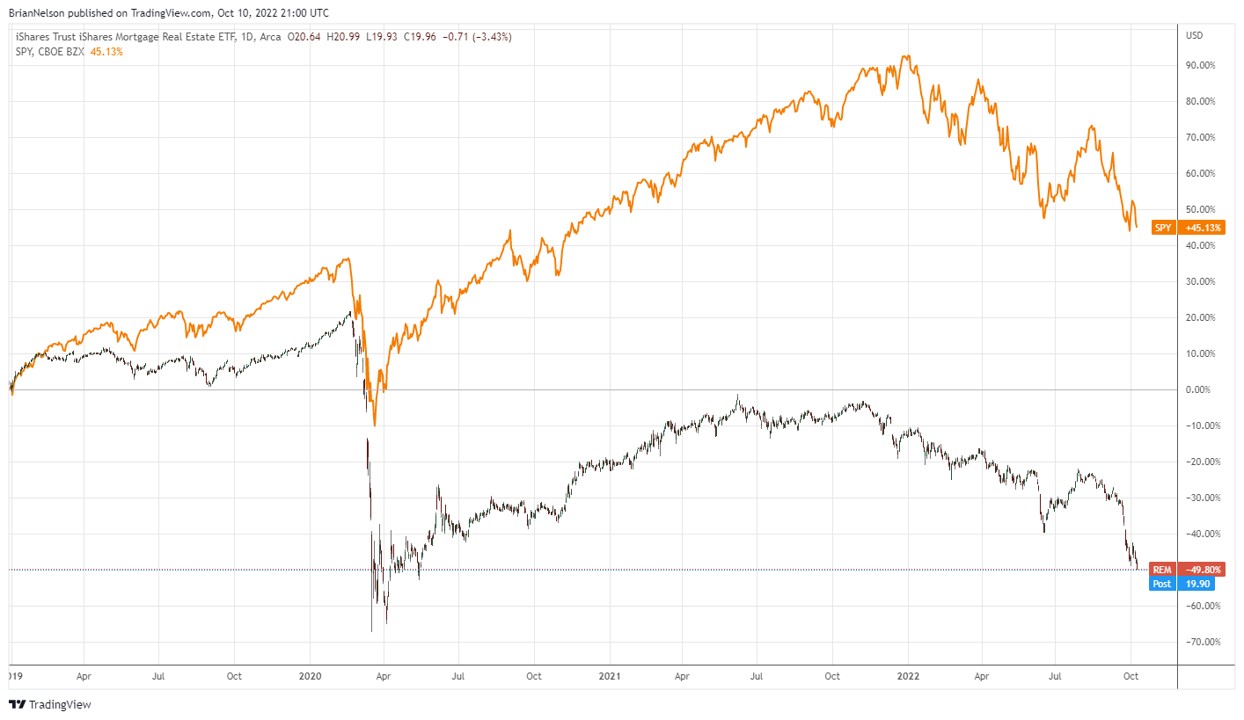
Image Source: Mortgage REITs have underperformed the broader stock market for years, and we don’t think individual investors and financial advisors should be dabbling in the mortgage markets via these instruments.
By Brian Nelson, CFA
On September 28, mortgage REIT (“mREIT”) Invesco Mortgage Capital (IVR) cut its dividend 28%, to $0.65 per common share. The bond markets have been experiencing a lot of pain of late, and mortgage rates have shot up considerably since the Fed started hiking. We think this spells trouble for mortgage REITs, which already suffer from highly unpredictable mortgage market dynamics.
So far in 2022, the iShares Mortgage Real Estate Capped ETF (REM) has fallen more than 40% (on a price-only basis), and while its forward estimated dividend yield of ~12.7% is a head-turner, it’s hard to get excited about that level when it’s likely many additional mortgage REITs may have to cut their payouts. We don’t like the economics of the mortgage REIT business either.
For starters, the book value of most mREITs is severely impacted by rising interest rates. As interest rates rise, unrealized losses on investments are marked to market, creating a devastating impact of comprehensive losses that often wipe out an mREIT’s period spread income, causing rapid and uncomfortable declines in book value.
Not only do higher rates serve to hurt an mREIT’s book value, but many mREITs have significant leverage that they use to magnify net interest rate spreads to achieve a gross return on equity. As debt-averse investors, we don’t like this dynamic either.
However, in our experience, we think the mREIT business is much more exposed to changes in comprehensive income, something that will be a stiff headwind due to rising rates. Here’s what Annaly Capital Management (NLY) had to say in late July about its second-quarter results, for example:
The operating environment remained challenging during the second quarter as persistent spread widening and rate volatility roiled financial markets while intensifying concerns about global economic growth contributed to risk-off sentiment. These pressures weighed on our book value, though our portfolio again generated earnings that exceeded our dividend. Despite these challenges, we remain constructive on the outlook for Agency MBS given historically attractive new investment returns and increased clarity from the Federal Reserve on the path forward for interest rate hikes and quantitative tightening.
At the end of June, Annaly’s book value per common share had fallen to $5.90 from $6.77 in March and $8.37 in the year-ago period. The company’s economic loss was 9.6% in the quarter due to the aforementioned dynamic of comprehensive losses that overwhelmed levered net interest spread income. Things may get worse as we close out 2022, too.
Concluding Thoughts
We don’t think individual investors and financial advisors should be dabbling in the mortgage markets via mortgage REITs. Invesco Mortgage Capital won’t be the last mortgage REIT to slash its payout during the tightening phase of this economic cycle.
As we have said time and time again, stay away from mortgage REITs! Don’t get lured in by their elevated yields.
—–
Tickerized for HYG, LQD, AGG, IVR, REM, CIM, ORC, MITT, CHMI, ARR, NLY, TWO, MFA, DX, EFC

Image Source: Value Trap
Valuentum members have access to our 16-page stock reports, Valuentum Buying Index ratings, Dividend Cushion ratios, fair value estimates and ranges, dividend reports and more. Not a member? Subscribe today. The first 14 days are free.
Brian Nelson owns shares in SPY, SCHG, QQQ, DIA, VOT, BITO, and IWM. Valuentum owns SPY, SCHG, QQQ, VOO, and DIA. Brian Nelson’s household owns shares in HON, DIS, HAS, NKE. Some of the other securities written about in this article may be included in Valuentum’s simulated newsletter portfolios. Contact Valuentum for more information about its editorial policies.