
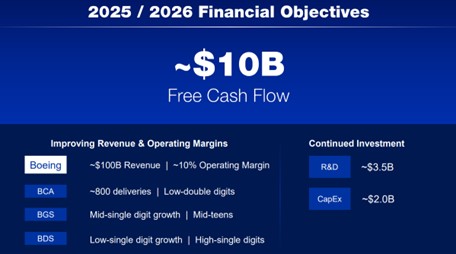
Image: Boeing is expecting to turn the corner with respect to positive free cash flow in 2022 and grow it to ~$10 billion annually by 2025/2026. We think this is achievable. Image Source: Boeing
By Brian Nelson, CFA
The breakout of COVID-19 wreaked havoc on the airline business and the commercial aircraft-making business alike. But has the commercial aerospace industry finally bottomed?
We took a hard look at our valuation model of Boeing (BA), and we’ve tweaked our near-term profitability assumptions and made material changes to our estimates of working capital assumptions in the out-years. Though the result was a lower fair value estimate for the aerospace giant, we reiterate that after several quarters of negative free cash flow, Boeing is expecting to be free cash flow positive in 2022, and we see this as a positive turn of events. Our updated fair value estimate of Boeing stands at $176 per share, with the company’s equity currently changing hands at ~$165 per share at the time of this writing.
When Boeing reported third-quarter results October 26, it recorded a massive GAAP loss per share of $5.49, as the company suffered weakness in its ‘Defense, Space & Security’ business across its KC-46A, VC-25B, MQ-25, T-7A and ‘Commercial Crew’ programs. With its ‘Commercial Airplanes’ business also recording an operating loss in the quarter, a few bright spots were its ‘Global Services’ operations, which pulled in $733 million in earnings from operations, a hefty backlog of 4,300 undelivered commercial airplanes ($381 billion), and positive free cash flow of $2.9 billion in the third quarter.
At Boeing’s 2022 Investor Conference November 2, the company had more encouraging news, with targets for as much as ~$10 billion in free cash flow in each of the years 2025 and 2026. In particular, management is targeting full-year 2022 free cash flow of $1.5-$2 billion, and ~$3-$5 billion in free cash flow for 2023. Though we’re expecting a bounce back in free cash flow greater than the company’s near-term targets in 2023 given our expectations for better working capital management, our mid-cycle (2025/2026) free cash flow expectations are about in-line with company targets, if not slightly more optimistic given the company’s massive backlog.
That said, Boeing still holds a huge net debt position of $42.9 billion at the end of the third quarter, so the aircraft-making behemoth is not out of the woods yet, but things are getting better – especially now that it has resumed 787 Dreamliner deliveries, which should benefit the entire aerospace supply chain. The firm’s investment-grade credit rating remains a top priority, and while it will continue to invest in its business, Boeing plans to use any excess cash for accelerated debt paydown, something that may come a bit easier given that it no longer pays a dividend.
We like the expected cash-flow improvement at Boeing and think this speaks positively to the aerospace supply chain, of which Honeywell (HON) is one of our favorite names. We expect to highlight another aerospace-related idea in the November edition of the Exclusive publication, to be released November 8.
Download Boeing’s 16-page report (pdf) >>
Honeywell Jumps on Third-Quarter Report, Strong Guidance >>
———————————————
About Our Name
But how, you will ask, does one decide what [stocks are] “attractive”? Most analysts feel they must choose between two approaches customarily thought to be in opposition: “value” and “growth,”…We view that as fuzzy thinking…Growth is always a component of value [and] the very term “value investing” is redundant.
— Warren Buffett, Berkshire Hathaway annual report, 1992
At Valuentum, we take Buffett’s thoughts one step further. We think the best opportunities arise from an understanding of a variety of investing disciplines in order to identify the most attractive stocks at any given time. Valuentum therefore analyzes each stock across a wide spectrum of philosophies, from deep value through momentum investing. And a combination of the two approaches found on each side of the spectrum (value/momentum) in a name couldn’t be more representative of what our analysts do here; hence, we’re called Valuentum.
———————————————
Brian Nelson owns shares in SPY, SCHG, QQQ, DIA, VOT, BITO, and IWM. Valuentum owns SPY, SCHG, QQQ, VOO, and DIA. Brian Nelson’s household owns shares in HON, DIS, HAS, NKE, and RSP. Some of the other securities written about in this article may be included in Valuentum’s simulated newsletter portfolios. Contact Valuentum for more information about its editorial policies.
Valuentum members have access to our 16-page stock reports, Valuentum Buying Index ratings, Dividend Cushion ratios, fair value estimates and ranges, dividend reports and more. Not a member? Subscribe today. The first 14 days are free.