
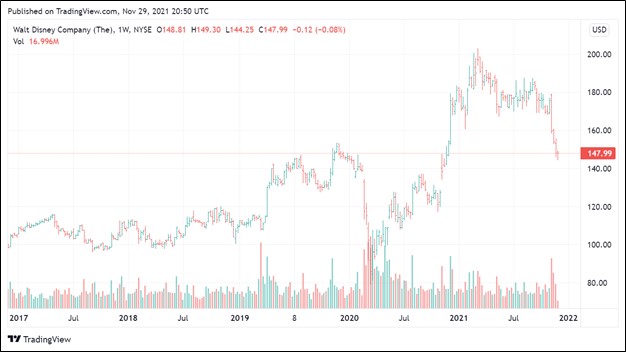
Image Shown: Shares of The Walt Disney Company have shifted lower over the past month, though are still bullish on its capital appreciation upside. Our fair value estimate sits at $192 per share of Disney.
By Callum Turcan
The Walt Disney Company (DIS) reported fourth-quarter earnings for fiscal 2021 (period ended October 2, 2021) on November 10 that missed consensus top- and bottom-line estimates. While the company’s ‘Disney Parks, Experiences and Products’ segment (includes its theme parks and resorts operations) staged an impressive turnaround last fiscal quarter, its ‘Disney Media and Entertainment Distribution’ segment (includes its video streaming businesses) grew at a slower pace than expected. Shares of Disney sold off after its latest earnings report, though we remain confident that the company’s free cash flow growth outlook remains stellar and continue to view Disney’s capital appreciation upside potential quite favorably. Disney is included as an idea in the Best Ideas Newsletter portfolio.
Financial Update
Last fiscal quarter, its Disney Parks, Experiences and Products segment reported 99% year-over-year sales growth and its segment-level operating income flipped from a loss of ~$0.95 billion in the same period the prior fiscal year to a profit of ~$0.65 billion in the fourth quarter of fiscal 2021. That turnaround highlights the favorable impact widespread coronavirus (‘COVID-19’) vaccine distribution efforts and the ending of many lockdown measures are having on Disney’s financial performance. Its Disney Media and Entertainment Distribution segment reported 9% year-over-year sales growth last fiscal quarter, though its segment-level operating income dropped by 39% year-over-year, hitting ~$0.95 billion, as Disney stepped up its investments in original content for its video streaming services.
Disney’s GAAP revenues grew 26% year-over-year last fiscal quarter, hitting $18.5 billion. Its GAAP diluted EPS came in at a positive $0.09 last fiscal quarter versus a loss in the same quarter the prior fiscal year. Disney exited fiscal 2021 with $16.0 billion in cash and cash equivalents on hand versus $5.9 billion in short-term debt and $48.5 billion in long-term debt, equal to a net debt load of $38.4 billion. Please note this does not include Disney’s $3.9 billion in long-term ‘investments’ line item at the end of fiscal 2021, which includes strategic assets such as its 50% equity stake in the A&E network.
The company’s net debt load swelled higher during the COVID-19 pandemic, and management has noted in the past that Disney has aimed to reduce its leverage ratio “to levels more consistent with a single A credit rating” before resuming share buybacks or dividend payouts, which we appreciate. In fiscal 2021, Disney generated $2.0 billion in free cash flow and did not repurchase a meaningful amount of its stock or payout any dividends. Back in May 2020, Disney announced it was suspending its semi-annual dividend and those payouts remain suspended.
As Disney’s free cash flow generating abilities steadily return, driven by the resumption of its theme parks and resorts operations, which historically have been its cash cows, we expect the firm’s balance sheet strength to recover over the coming fiscal years. We view Disney’s net debt load as manageable given its improving outlook, impressive cash flow generating abilities, and ample liquidity levels on hand.
Disney noted during its latest earnings call that the firm expects its capital expenditures to grow by $2.5 billion in fiscal 2022 (the current fiscal year) versus fiscal 2021 levels. As the company’s cash flows swell higher, Disney should have the capacity to make these investments. Beyond the likely recovery at its theme parks and resorts operations, its movie making business should rebound as households return in the theaters in earnest.
For instance, the company’s new animated film Encanto put up solid performance at the box office this past Thanksgiving holiday weekend, though there remains ample room for upside here as box office ticket sales remained subdued in the US (and elsewhere) versus pre-pandemic levels. As the pandemic eventually fades, keeping potential headwinds from variants of COVID-19 in mind, households should feel more comfortable returning to movie theaters.
Video Streaming Update
On a sequential basis, Disney+ added 2.1 million net paying subscribers to its service in the fiscal fourth quarter (ending the fiscal quarter at 118.1 million subscribers) while EPSN+ added 2.2 million net paying subscribers (ending the fiscal quarter at 17.1 million subscribers) and Hulu added 1.0 million net paying subscribers (ending the fiscal quarter at 43.8 million) during this period. While decent, the market was expecting more.
During the worst of the COVID-19 pandemic, demand boomed for video streaming services at a time when production activities for major TV shows and movies were negatively impacted. For a time, companies were able to continue refreshing their original content lineup and utilize third-party content to fill in the gaps, but eventually those strategies wore out. Disney was no exception to these dynamics.
While demand boomed across the board for its video streaming services, the company has not been able to produce enough original content for these services fast enough, specifically for its Disney+ offering. That includes titles that leverage its Star Wars, Pixar, National Geographic, Marvel, and Disney intellectual properties. However, Disney has a solid plan to get its content lineup back in order. During Disney’s latest earnings call management noted that (emphasis added, lightly edited):
“In total, we are nearly doubling the amount of original content from our marquee brands, Disney, Marvel, Pixar, Star Wars, and National Geographic coming to Disney+ in FY ’22, with the majority of our highly anticipated titles arriving July through September… We recognize that the single most effective way to grow our streaming platforms worldwide is with great content, and we are singularly focused on making new, high-quality entertainment, including local and regional content that we believe will resonate with audiences.
Of note, we have 340 plus local original titles in various stages of development and production for our [direct-to-consumer] platforms over the next few years. As you know… we expect our total content expense to be between $8 and $9 billion in fiscal 2024, and we will now be increasing that investment further with the primary driver being more local and regional content. We are expanding our global reach by introducing Disney+ in additional markets around the world.” —Bob Chapek, CEO of Disney
Additionally, management noted this during Disney’s latest earnings call (lightly edited):
“[The fourth quarter of fiscal 2022] will be the first time in Disney+ history that we plan to release original content throughout the quarter from Disney, Marvel, Star Wars, Pixar, and Nat Geo all in one quarter.” — Christine McCarthy, Senior EVP and CFO of Disney
Disney reiterated its commitment to achieve 230-260 million paying subscribers at its Disney+ service by fiscal 2024 during its latest earnings call, the same fiscal year that it aims to achieve profitability at the service. The company is spending handsomely on original content to support growth at its video streaming services, and more on rolling out these services around the world (its spending is greater than originally expected).
Management noted that “in just 2 short years, we’re now in over 60 countries and more than 20 languages, and next year, we plan to bring Disney+ to consumers in 50 plus additional countries, including in Central, Eastern Europe, The Middle East, and South Africa” during Disney’s latest earnings call. The firm recently launched Disney+ in several East Asian markets including South Korea, Taiwan, and Hong Kong.
We continue to view Disney’s video streaming ambitions quite favorably. Disney owns 67% of Hulu with Comcast Corp (CMCSA) owning the remaining 33%. Starting in January 2024, Disney could compel Comcast to sell it its stake in Hulu to Disney, or Comcast could compel Disney to acquire its stake in Hulu via an existing put/call agreement. This is one of the big reasons why Disney will likely not resume meaningful share buybacks or restart its dividend program anytime soon, as the firm will need to build up capital to acquire the 33% stake in Hulu that it does not already own.
Reportedly, there are arguments over the price such a stake should fetch according to the WSJ. The put/call agreement between Disney and Comcast established a floor equity value of $27.5 billion for all of Hulu, though reporting by the WSJ indicates that Comcast views the equity value of Hulu at multiplies of that level. Comcast has reportedly mulled pulling some of its NBCUniversal (a subsidiary of Comcast) content off Hulu and putting that content on its new Peacock video streaming service, though such a move could have significant implications for Comcast’s bottom-line. We are monitoring these events closely, though in any event, Hulu has ample content to keep its subscriber base entertained. On a final note, Hulu has been steadily pushing through pricing increases, including for its live TV offering, while maintaining and growing its paying subscriber base.
Concluding Thoughts
The slowdown in Disney’s video streaming subscriber growth trajectory weighed on the company’s stock price in the wake of its latest earnings report, though please note that this busienss has still put up tremendous performance. For instance, from the end of Disney’s first quarter of fiscal 2020 (period ended December 28, 2019) to the end of its fiscal 2021, the firm’s core video streaming services (Disney+, ESPN+, Hulu) have added 115.5 million net paying subscribers combined, including 91.6 million net paying subscribers at its Disney+ service.
After that kind of performance, Disney was bound to see its paid subscriber growth slow down relative to the breakneck performance seen over the past two years, though we expect its video streaming growth trajectory will pick up going forward as it expands into new international markets and adds additional original content to these services. Disney also recently launched its Star video streaming service which is geared towards international markets, providing Disney with another source of upside on this front.
We remain incredibly optimistic that Disney’s video streaming strategy will eventually create an immense cash flow cow that churns out sizable profits, though the firm needs to scale up this business first. Original content investments are how Disney is differentiating its service from the likes of Netflix Inc’s (NFLX) namesake service and Amazon Inc’s (AMZN) Prime service. We continue to like Disney as an idea in our Best Ideas Newsletter portfolio. Our fair value estimate sits at $192 per share of DIS, well above where Disney is trading at as of this writing. We see room for ample capital appreciation upside potential at shares of Disney going forward.
—–
Telecom Services Industry – CMCSA, LUMN, DISH, T, TMUS, VZ, SBAC, AMT, CCI, VIAC
Related: AMZN, NFLX, AMC, MGMB, SONY, CNNWF, CNK, IMAX, MCS, RDI, CPXGF, NCMI, GME, VIA, VIACA
Valuentum members have access to our 16-page stock reports, Valuentum Buying Index ratings, Dividend Cushion ratios, fair value estimates and ranges, dividend reports and more. Not a member? Subscribe today. The first 14 days are free.
Callum Turcan does not own shares in any of the securities mentioned above. The Walt Disney Company (DIS) is included in Valuentum’s simulated Best Ideas Newsletter portfolio. Crown Castle International Corp (CCI) is included in Valuentum’s simulated High Yield Dividend Newsletter portfolio. Some of the other companies written about in this article may be included in Valuentum’s simulated newsletter portfolios. Contact Valuentum for more information about its editorial policies.