
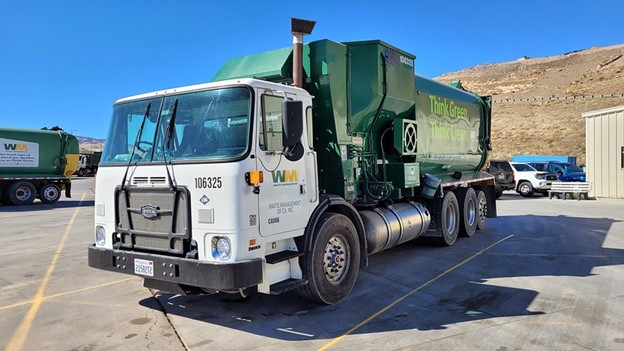
Image Source: TheInvertedFan
By Brian Nelson, CFA
Industry economics in the municipal solid waste industry are generally easy to understand. Industry pricing power essentially emanates from disposal operations. Waste generated, for example, must end up somewhere, and therefore whichever entity has the disposal operations has the power to set the bar with respect to pricing, directly or indirectly, from transfer facilities all the way through collections within certain regions. After all, garbage pick-up operators won’t be in business for long if they have to pay more to dispose of waste than they charge to pick it up. It may not be a glamourous business, but it is a very good one, and those with disposal operations tend to rule the land.
As for the key municipal solid waste operators in the US, Waste Management (WM) and Republic Services (RSG) have the largest networks of disposal operations. At the end of 2022, for example, Waste Management owned or operated 259 landfill sites, the largest network of landfills in North America. That number stands at 206 for Republic Services and inclusive of non-municipal solid waste landfills, 100 at number three, Waste Connections (WCN). These companies dominate the municipal solid waste industry and will for some time to come. We view disposal pricing as having oligopolistic tendencies, even if collection operations face some of the most intense pricing competition of any industry. From our perspective, waste haulers have some of the best business models out there.
On February 12, Waste Management reported excellent fourth quarter results that showed revenue and non-GAAP earnings per share coming in better than expectations. Revenue advanced 5.7% in the quarter thanks to strong core pricing increases, while the firm improved operating expenses as a percentage of revenue by 240 basis points to drive adjusted operating EBITDA 14.7% higher. For the full year, net cash from operations increased 4%, to $4.72 billion, while sustainability initiatives ate into free cash flow generation, which declined 3.7%, to $1.9 billion in 2023. Waste Management continues to be shareholder friendly, returning $2.44 billion to shareholders in 2023, inclusive of $1.3 billion in buybacks. Here is what the company had to say about the performance in the press release:
Our operating and financial results in the second half of 2023 surpassed expectations driven by strong execution on our pricing and operating excellence programs. Our team continues to make progress in optimizing our cost structure, and our investments in people, technology, and assets accelerated margin expansion ahead of plan in the fourth quarter. During the fourth quarter, our collection and disposal business performance powered our total Company adjusted operating EBITDA growth of 15% and record adjusted margin of 29.9%. Our performance in 2023, particularly the momentum built during the second half of the year, positions us well to sustain growth throughout 2024.
Looking out to 2024, Waste Management expects revenue to expand 6%-7%, with core price increases powering most of the advance, with collection and disposal volume growth targeted to increase 1%. Adjusted operating EBITDA is expected to increase ~$450 million at the midpoint of its guidance range for the year ($6.275-$6.425 billion), driven in part by a 30 basis-point increase in the firm’s adjusted operating EBITDA margin. The company is targeting total capital spending in the range of $2.2-$2.3 billion for 2023, while free cash flow including its sustainability initiatives is expected at $1.9-$2.05 billion. Cash dividend payments were ~$1.14 billion in 2023, so Waste Management has ample room to continue to raise the payout.

Image: 2023 Sustainability Report
As we look at Waste Management’s ESG initiatives, it’s hard not to like the company’s efforts. The company remains focused on committing capital to renewable natural gas projects as well as recycling assets, with $2.8-$2.9 billion earmarked for such initiatives from 2022-2026. Its 2030 goals are noteworthy, too. Striving for the continuous reuse of materials, it plans to increase recovery of materials by 60% to 25 million tons per year by 2030. Reducing absolute Scope 1 and 2 GHG emissions by more than 40% by 2031 is yet another target, and the firm is working hard to establish female and minority representation from front line to management positions. As a garbage handler and disposal operator, Waste Management’s initiatives won’t be easy to attain, and we’re fans of the company’s efforts in this area.
Concluding Thoughts
There are few industry economics that we like better than the waste management industry, and Waste Management is the leader in this oligopolistic environment. Management plans to continue buying back stock, and the firm intends to raise its dividend by $0.20 per share, to $3.00 on an annual basis, making it 21 consecutive years that it has raised its payout. Though free cash flow will face pressure from its sustainability initiatives, the company’s free cash flow generation remains robust. At a $3 per-share annualized dividend, shares of Waste Management yield ~1.6% on a forward-looking basis. Though we don’t include Waste Management in the newsletter portfolios (we include peer Republic Services in the Best Ideas Newsletter portfolio and Dividend Growth Newsletter portfolio), the company is one of our favorites for consideration.
—–
Tickerized for holdings in the EVX.
Brian Nelson owns shares in SPY, SCHG, QQQ, DIA, VOT, RSP, and IWM. Valuentum owns SPY, SCHG, QQQ, VOO, and DIA. Brian Nelson’s household owns shares in HON, DIS, HAS, NKE, DIA, RSP, SCHG, QQQ, QQQM, and VOO. Some of the other securities written about in this article may be included in Valuentum’s simulated newsletter portfolios. Contact Valuentum for more information about its editorial policies.
Valuentum members have access to our 16-page stock reports, Valuentum Buying Index ratings, Dividend Cushion ratios, fair value estimates and ranges, dividend reports and more. Not a member? Subscribe today. The first 14 days are free.