
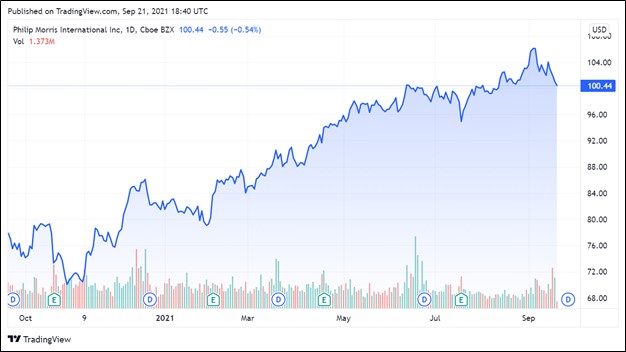
Image Shown: Shares of Philip Morris International Inc have performed quite well over the past year.
By Callum Turcan
One of our favorite high-yielding plays is Philip Morris International Inc (PM)—5.0% yield—the tobacco giant behind the Marlboro cigarette brand (excluding the US market) and the incredibly popular IQOS product, a heated tobacco unit (‘HTU’) offering . Shares of PM are included as in idea in the High Yield Dividend Newsletter portfolio (more on that here) and as of this writing, Philip Morris’ stock price is up 23% year-to-date before taking dividend considerations into account. The top end of our fair value estimate range sits at $119 per share of Philip Morris, indicating there is ample room for shares of PM to run higher still.
Financial Update
When Philip Morris gave a presentation at a consumer staples event hosted by Barclays PLC (BCS) in September 2021, management reiterated the tobacco giant’s reported and non-GAAP adjusted diluted EPS guidance for 2021. Philip Morris expects its organic (excluding foreign currency movements) adjusted diluted EPS will grow by 12%-14% in 2021 over 2020 levels. Within the press release published in conjunction with its recent investor presentation, management noted that the firm is now targeting for growth in the upper end of that range.

Image Shown: Philip Morris is guiding for double-digit annual adjusted EPS growth this year. Image Source: Philip Morris – September 2021 IR Presentation
Please note that Philip Morris is expecting to hit its EPS target even though the ongoing semiconductor shortage is weighing negatively on its ability to keep up brisk demand for its HTU offerings. The company noted that it now expects its HTU shipment volumes to fall towards the lower end of its 95-100 billion unit range for 2021, though that is still up sharply from ~76 billion units in 2020 and ~60 billion units in 2019. In August 2021, Philip Morris launched IQOS ILUMA product in Japan and initial demand has been quite strong according to the firm. Philip Morris is navigating exogenous headwinds rather well, in our view.
In September 2021, Philip Morris raised its quarterly dividend by just over 4% sequentially to $1.25 per share, bringing its annualized payout going forward up to $5.00 per share. The company’s strong performance of late has apparently given management the confidence to continue growing Philip Morris’ already generous payout, which we appreciate. In our July 2021 article Philip Morris’ Transformation Continues we covered its financials, recent guidance updates, and business strategy in great detail (link here).
Acquisition Update
In August 2021, Phillip Morris announced that it was acquiring a respiratory drug development company, OtiTopic, though financial terms were not disclosed beyond Philip Morris noting the deal would not materially impact its adjusted diluted EPS in 2021. OtiTopic has “a late-stage inhalable acetylsalicylic acid (‘ASA’) treatment for acute myocardial infarction. If approved, the treatment can address the significant unmet medical need of the over 83 million people, in the U.S. alone, at intermediate to high risk for myocardial infarction” according to the press release announcing the deal. Here is some additional information from that press release (emphasis added):
Following the completion of clinical trials and pending approvals by the U.S. Food and Drug Administration (‘FDA’), PMI can leverage its expertise and the capabilities of other companies in the Beyond Nicotine portfolio to bring ASPRIHALE to market.
ASPRIHALE—a patented, dry powder inhalation of ASA delivered through a unique self-administered aerosol—is expected to move from clinical trials to filing with FDA for approval in 2022. Early clinical trials have shown that the product system catalyzed peak plasma concentration and the desired pharmacodynamic effect, i.e., inhibition of platelet aggregation in two minutes compared with 20 minutes for coated chewable aspirin. This speed is unprecedented and has significant potential implications for improving the survival of patients at risk of heart attacks…
PMI’s Beyond Nicotine vision is part of a larger transformation that puts health, science, technology, and sustainability at the heart of PMI’s future, delivering products and solutions that aim to improve people’s lives and deliver a net positive impact on society. Building on the company’s investment and expertise in aerosol chemistry and physics, device technology, clinical research, and best-in-class preclinical safety and inhalation models, PMI is developing a pipeline focused on inhaled therapeutics for medical and wellness applications.
On September 15, Philip Morris announced it had completed the acquisition of Fertin Pharma which operated a sizable contract development and manufacturing organization (‘CDMO’) across Canada, Denmark, and India. In 2020, Fertin Pharma generated a bit under $0.2 billion in net revenues. Fertin Pharma’s business “specializ[es] in the research, development and production of gums, pouches, liquefiable tablets, and other solid oral systems for the delivery of active ingredients, including nicotine, where it is a leading producer of Nicotine Replacement Therapy (‘NRT’) solutions” though the goal is to expand its operations into health and wellness offerings. This deal, which had an enterprise value of ~$0.8 billion, is expected to have a minimal impact on Philip Morris’ adjusted diluted EPS in 2021.
Philip Morris announced on September 16 that its offer for Vectura Group had become unconditional after it had acquired or received valid acceptances for just under 75% of Vectura Group’s shares, above the threshold required to move forward with the deal as planned. On September 21, Philip Morris published an 8-K SEC filing noting that this figure was now above 75% of Ventura Group’s shares and that should Philip Morris and its subsidiary “acquire or receive acceptances under the extended offer period of 90 per cent or more of the outstanding shares of Vectura” the company “will exercise its rights under U.K. law to acquire the remaining shares of Vectura on a compulsory basis on the same terms as the offer, which is 165 pence per share of Vectura.”
Now Philip Morris is moving towards delisting Vectura Group from the London Stock Exchange and making it a private subsidiary. It appears the deal is on its way towards being completed relatively soon after facing some headwinds from health groups and contending with a bidding war against Carlyle Group Inc (CG). Phillip Morris’ deal for Vectura Group has an enterprise value of GBP£1.1 billion, or approximately USD$1.5 billion as of this writing based on current exchange rates.
Just like its other two deals, Philip Morris does not expect its pending Vectura Group acquisition to have a material impact on its adjusted diluted EPS performance in 2021. Vectura Group “is a provider of innovative inhaled drug delivery solutions that enable partners to bring their medicines to patients. The company has 13 key inhaled products and 11 non-inhaled products marketed by major global pharmaceutical partners” and in 2020, the firm generated ~$0.25 billion in net revenue according to a recent press release. Furthermore, Vectura Group has “a diverse portfolio of partnerships for drugs in clinical development” that Philip Morris can help progress towards commercialization. These deals are part of Philip Morris’ plan to generate at least $1.0 billion in revenues from products not directly associated with nicotine by 2025 (its ‘Beyond Nicotine’ strategy).
Bigger picture, Philip Morris’ management team under its CEO Jacek Olczak, who took the top job this past May, recognizes that the company needs to adapt to stay relevant in the long run. On a global basis, the cigarette business is in terminal decline as consumers continue to shift away from tobacco (resulting in declining annual sales volumes). However, the tremendous pricing power of Marlboro and other cigarette brands combined with the relatively inelastic demand curve for these addictive products enables a company like Philip Morris to maintain and even grow its cash flows in the face of such headwinds.
Eventually, that strategy will hit a wall which is why Philip Morris is looking towards the future. Pharmaceutical products are a core focus, as are “selfcare wellness products, including over-the-counter solutions and supplements for better living in areas such as sleep, energy, calm, and focus” according to a recent press release though that is a tad vague. In our view, the company’s plans will likely become better defined in the coming quarters as it integrates its recent and pending acquisitions into its broader operations.
Concluding Thoughts
We are huge fans of Philip Morris and appreciate its pivot towards pharmaceuticals and other products. Investors are steadily warming up to the name as its core cigarette and other tobacco products business continues to churn out gobs of free cash flow while management’s initiatives are improving the company’s growth outlook over the long haul. We are keeping a close eye on Philip Morris’ strategic pivot.
Philip Morris’ 16-page Stock Report >>
Philip Morris’ Dividend Report >>
—–
Recession Resistant Industry – BUD, CL, CLX, CPB, COST, FDP, GIS, HRL, K, KDP, KHC, KMB, KO, KR, MDLZ, MKC, MO, PEP, PG, PM, SJM, TAP, TGT, TSN, WMT, CHD, SYY, ADM, LANC, CASY
Tickerized for PM, CG, VDC, VEGPF, MO, JAPAY, BTI, SWM, TPB, VGR, IMBBY, OGI, RLX, BCS
Valuentum members have access to our 16-page stock reports, Valuentum Buying Index ratings, Dividend Cushion ratios, fair value estimates and ranges, dividend reports and more. Not a member? Subscribe today. The first 14 days are free.
Callum Turcan does not own shares in any of the securities mentioned above. Philip Morris International Inc (PM) and Vanguard Consumer Staples ETF (VDC) are both included in Valuentum’s simulated High Yield Dividend Newsletter portfolio. Some of the other companies written about in this article may be included in Valuentum’s simulated newsletter portfolios. Contact Valuentum for more information about its editorial policies.