
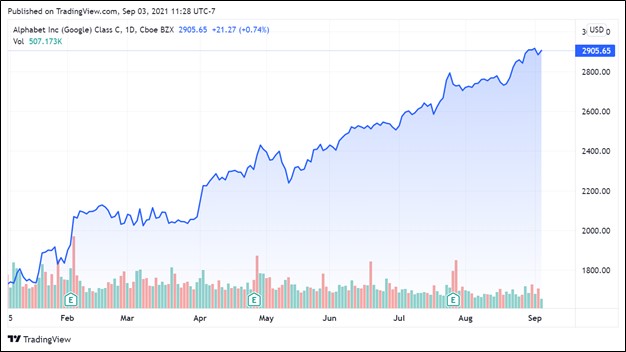
Image Shown: Shares of Alphabet Inc Class C have boomed higher year-to-date as of early-September 2021. We see ample room for additional upside.
By Callum Turcan
We are enormous fans of large cap US equities because these entities then to be tremendous free cash flow generators, generally have net cash rich balance sheets, and their promising growth outlooks are underpinned by secular growth tailwinds. Alphabet Inc (GOOG) (GOOGL) fits the bill, and we include Alphabet Class C shares as a top-weighted idea in our Best Ideas Newsletter portfolio. Let’s provide some updates on the company’s self-driving taxi ambitions in this note concerning its Waymo spinoff.
Self-Driving Taxi Upside
Alphabet announced that it was spinning off Waymo, the company’s self-driving unit, back in 2016 to create a standalone entity that would no longer be lumped together with its various other longshot opportunities. Waymo got its start back in 2009 as the Google Self-Driving Car Project and has since grown into one of the top autonomous driving companies out there (possibly even the number one self-driving company in terms of technological capabilities and commercial potential).
The firm has been testing out its service in the Phoenix metropolitan area in Arizona for some time now. Riders using the Waymo One app can now get a fully autonomous self-driving taxi offering in the area, though the service is limited to the Phoenix metropolitan region (includes the East Valley of Phoenix such as Chandler, Gilbert, Mesa, and Tempe).
Waymo’s pilot program in Arizona began accepting select riders back in 2017 with a human driver behind the wheel for safety. Over the following years, select groups of riders were able to experience a fully autonomous self-driving taxi service if they signed a non-disclosure agreement (‘NDA’). In October 2020, Waymo announced it was opening the Waymo One app to all potential customers and noted that soon thereafter all of its rides in the region would be fully driverless (in the sense there would not be a human being directly behind the wheel).
In June 2021, CNBC noted Waymo launched a $2.5 billion funding round, which along with Alphabet included a litany of outside investors including the Canada Pension Plan Investment Board, Silver Lake, Andreessen Horowitz, AutoNation Inc (AN), and various other entities. This funding round comes as Waymo is moving its pilot project into San Francisco, California.
On August 24, Waymo posted a blog that noted its Waymo One Trusted Tester Program was coming to San Francisco. The blog noted Waymo had been testing in the region for over a decade and that the company had begun offering autonomous rides to its employees this year in preparation for the wider launch of its pilot program. Waymo intends to “begin with an initial group and welcome more riders in the weeks to come” and that this select group “will be able to hail an autonomous ride in one of our all-electric Jaguar I-PACE vehicles equipped with the fifth-generation Waymo Driver.”
Transitioning from the relatively calmer and flat suburban areas of Phoenix to the chaotic (in terms of traffic and pedestrian activity) and hilly regions of San Francisco will be a difficult challenge for Waymo’s self-driving taxi pilot program. In our view, the company is up to the task. Waymo slowly and methodologically rolled out its pilot program and has significantly improved its self-driving technology in recent years, aided by ample data generated through its pilot programs.
Long-Term Upside
We are intrigued by the potential long-term upside as the self-driving taxi space could one day–years and years down the road–become the new norm of transportation. That is not to imply that there will not be an interest in drivers still taking the wheel, but we are at a point in time where self-driving taxi services are no longer confined to the realm of science fiction.
Waymo could potentially become a more scalable business than Uber Technologies Inc (UBER) and LYFT Inc (LYFT) given that the incremental cost of providing a self-driving taxi ride to its user base should be significantly cheaper as it would not need to also compensate the human driver for providing the service. Additionally, utilizing electric vehicles (‘EVs’) represents Waymo’s way of keeping a lid of fuel expenses.
Please note that as things stand today, Waymo is not generating a significant amount, if any, revenue from these programs as these are still early days. That is why the company continues to raise funds from both Alphabet and outside investors. Back in March 2020, Waymo announced it had raised $2.25 billion (which was later upsized to $3.2 billion as of July 30, 2020) that included Alphabet along with numerous other investors.
Alphabet separated Waymo from its core businesses back in 2016, in part because the company wanted its various longshot ventures to prove they could raise capital on their own merits — in other words, to ensure that Alphabet was not funding a series of pet projects with no chance to generate commercial sales in the future. The immense interest seen from outside investors of late in Waymo lends credence to the company’s promising future. Alphabet retains a sizable economic stake in Waymo that could one day become needle-moving.
In April 2021, Waymo’s then-CEO John Krafcik who had led the firm for five years, announced he was stepping down. Dmitri Dolgov, one of the founders of the Google Self-Driving Car Project, and Tekedra Mawakana, then COO of Waymo, took over as co-CEOs. Some speculate that this was due to Waymo not moving fast enough in terms of its development timetable. Looking ahead, Waymo remains in good hands.
Concluding Thoughts
We are huge fans of Alphabet and include Alphabet Class C shares (ticker: GOOG) as a top-weighted holding in the Best Ideas Newsletter portfolio. Our fair value estimate for Alphabet Class C shares sits at $3,500 per share, well above where GOOG is trading at as of this writing. Should Waymo one day get commercialized, that upside is purely incremental to our fair value estimate, highlighting why we are such huge fans of the digital advertising behemoth.
—–
Technology Giants Industry – FB, AAPL, GOOG, AMZN, MSFT, CSCO, V, MA, PYPL, INTC, ORCL, QCOM, TWTR, IBM, ADBE, NVDA, CRM, AMD, AVGO, BABA, BKNG, BIDU, TSM, FFIV, TXN, EBAY, ADP, PAYX, MU, KFY, MAN, KLAC, LRCX, AMAT, ADI
Tickerized for GOOG, GOOGL, FB, AMZN, AAPL, AN, UBER, LYFT, TSLA, IDRV
Valuentum members have access to our 16-page stock reports, Valuentum Buying Index ratings, Dividend Cushion ratios, fair value estimates and ranges, dividend reports and more. Not a member? Subscribe today. The first 14 days are free.
Callum Turcan does not own shares in any of the securities mentioned above. Apple Inc (AAPL), Cisco Systems Inc (CSCO) and Microsoft Corporation (MSFT) are all included in both Valuentum’s simulated Best Ideas Newsletter portfolio and simulated Dividend Growth Newsletter portfolio. Alphabet Inc (GOOG) Class C shares, Facebook Inc (FB), Korn Ferry (KFY), PayPal Holdings Inc (PYPL) and Visa Inc (V) are all included in Valuentum’s simulated Best Ideas Newsletter portfolio. Oracle Corporation (ORCL) and Qualcomm Inc (QCOM) are both included in Valuentum’s simulated Dividend Growth Newsletter portfolio. Some of the other companies written about in this article may be included in Valuentum’s simulated newsletter portfolios. Contact Valuentum for more information about its editorial policies.