
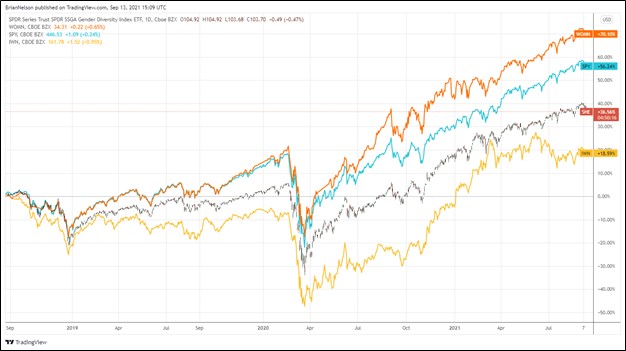
Image: The Impact Shares’ YWCA Women’s Empowerment ETF (WOMN) has trounced the S&P 500 since inception, while the SPDR SSGA Gender Diversity Index ETF (SHE) has bested the quantitatively-hailed small cap value ETF over the same time period.
By Valuentum Analysts
There has been a plethora of research over the years regarding the value of diversity on teams, in corporate boardrooms, and across asset management. The CFA Institute defines diversity as “the spectrum of human attributes, perspectives, identities, and backgrounds,” and notes that “the discussion around motivations for pursuing diversity in investment management often revolves around two main areas: ‘the business case for diversity’ (i.e., with more diverse perspectives, business outcomes will improve) and ‘because it is the right thing to do.’
One of the forms of diversity is gender diversity. According to the most recent census data estimates, in the United States just over half (50.8%) of the population is female. That number doesn’t account for those who don’t identify as male or female, since the definition the Census Bureau uses relies strictly on the “biological attributes of men and women (chromosomes, anatomy, and hormones).” Though this doesn’t help explain the full spectrum of gender diversity–since it doesn’t include inclusive options–it does provide a benchmark to start from, given that women participate in the workforce at levels out of proportion with current demographics.
It has been documented that diverse teams create more innovative ideas and creativity, which can serve as quite an advantage in industries where margins are slim, or there are few barriers to entry. While a 2019 study summarized in the Harvard Business Review indicated that the value of gender diversity is highly context-dependent and tends to have the greatest benefit where it is already valued, the corporate environment, and arguably the stock market, itself, are a few of those areas where value has been demonstrated.
Firms that show a commitment to diversity have been rewarded by investors in the past. According to Stephen Turban, Dan Wu, and Letian (LT) Zhang, “By most measures, the global business community is becoming more supportive of women and of women’s importance in economy. This leads to a positive feedback loop – firms that support gender diversity will capture these benefits earlier, leading them to outlast their competitors.” As reported by the CFA Institute, a recently published PwC Global survey showed that “85 percent of financial services CEOs polled said promoting inclusion and diversity helps enhance business performance.”
Women in the workforce have suffered during the Covid-19 pandemic, staying home to care for children and sick family members more often than their male counterparts. Though male and female participation dropped in the early months of the pandemic, US Bureau of Labor Statistics data shows that the percentage of women in the labor force dropped from 59.2% in February 2020 to 57% in February 2021, while the percentage of men in the workforce dropped from 71.6% to 69.9% over the same time. From this participation gap of 12-13 percentage points, a gap that grows during times of economic stress, there are clear opportunities for corporations to concentrate on increasing gender diversity, but also in finding ways to better accommodate the needs of women in the workforce.
Additionally, in 2020, 36.7% of men and 38.3% of women in the US had completed four years of college or more, and that percentage will likely continue to increase for women as they outnumber men in college attendance. According to the National Student Clearinghouse, there are approximately 46.9% more women in colleges and universities than men. Corporate teams, boardrooms, and the financial industry will have a tremendous opportunity to capitalize on the unique talents of women who will provide industries with new ways to capture demand trends. Many companies are recognizing this, as there are a record number of female CEOs at Fortune 500 companies these days. However, there are still only 41 female CEOs in the Fortune 500 executive suite (8.2%), but a percentage that we think will increase in coming years.
Some female CEOs at the top include Karen Lynch of CVS Health (CVS), Mary Barra of General Motors (GM), Rosalind Brewer of Walgreens Boots Alliance (WBA), Gail Boudreaux of Anthem (ANTM), Jane Fraser of Citigroup (C), Carol Tomé of United Parcel Service (UPS), Safra Catz of Oracle (ORCL), Sonia Syngal of Gap (GPS), and Lisa Su, Ph.D., of Advanced Micro Devices (AMD). Dividend Growth Newsletter portfolio holding Oracle has been a standout outperformer this year, up more than 38% versus the market return of ~19%, both on a price-only basis.
A Couple Pioneering ETFs
For those looking for ETFs housing companies that are paying attention to the importance of gender diversity, there are a couple options.
Impact Shares’ YWCA Women’s Empowerment ETF (WOMN) tracks the performance of the Morningstar (MORN) Women’s Empowerment Index. Some of the largest holdings include familiar names such as Microsoft (MSFT), Apple (AAPL), Amazon (AMZN), NVIDIA (NVDA), Facebook (FB), Alphabet (GOOGL, GOOG), Adobe (ADBE), Salesforce (CRM), and Johnson & Johnson (JNJ) — companies that have shown a commitment to gender equality and women’s empowerment (these top 10 companies make up about ~35% of the ETF’s portfolio). Though WOMN is rather small at $31.5 million in AUM and has a rather high expense ratio of 0.75%, all net advisory fees from the management of the WOMN ETF are donated to the YWCA.
SPDR SSGA Gender Diversity Index ETF (SHE) offers another alternative. The goal of the SSGA Gender Diversity Index is to include companies that have greater gender diversity specifically within senior leadership than other firms in the sector. This focus allows SHE to weight more heavily other entities, rather than emphasizing technology at the top the way that WOMN does (note, both ETFs have ~32% weightings in technology). Some of the biggest holdings of SHE include Disney (DIS), PayPal (PYPL), Salesforce.com, Visa (V), Netflix (NFLX), and United Health (UNH) — all of which garner weightings north of 4% each. SHE has a much more affordable expense ratio of 0.2% than WOMN, and a much larger AUM of ~$281 million. SHE has an SEC yield of ~0.83%.
Concluding Thoughts
The lower expense ratio and larger asset base at SHE may make it a relatively more attractive ETF for more conservative investors, but we like the overweighting of large cap tech in WOMN, despite its higher expense ratio and more speculative nature given the fewer assets backing it. Since WOMN began trading in late 2018, shares of the ETF have advanced ~70%, beating the S&P return of ~56%, both measured on a price-only basis. Though SHE has trailed the S&P 500 over this time, the ETF’s return still bested quantitatively-hailed small cap value’s (IWN) meager showing of ~19% during this time, both measured on a price-only basis. The long and short of gender diversity is that not only is more gender diversity the “right thing to do,” but the investment case is quite strong.
—–
Valuentum members have access to our 16-page stock reports, Valuentum Buying Index ratings, Dividend Cushion ratios, fair value estimates and ranges, dividend reports and more. Not a member? Subscribe today. The first 14 days are free.
Some of the other companies written about in this article may be included in Valuentum’s simulated newsletter portfolios. Contact Valuentum for more information about its editorial policies.