
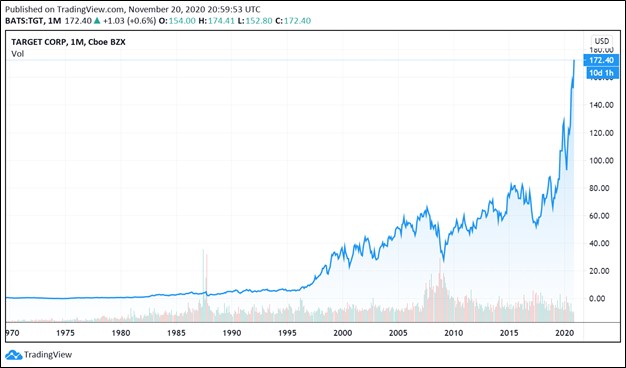
Image Shown: Shares of Target Corporation are now trading near their all-time highs as of this writing.
By Callum Turcan
Shares of Target Corporation (TGT) recently reached an all-time high after the company reported third quarter earnings for fiscal 2020 (period ended October 31, 2020) on November 18 that smashed past consensus estimates on both the top- and bottom-lines. The top end of our fair value estimate range sits at $182 per share, and as of this writing, shares of TGT are trading near $172, indicating Target appears fairly valued at this time. Shares of TGT yield a decent ~1.6% as of this writing, and we give Target a “GOOD” Dividend Safety rating given its impressive cash flow profile.
Operational Update
E-commerce and omni-channel selling capabilities have been a big theme for traditional brick-and-mortar retailers over the past few quarters. When the ongoing coronavirus (‘COVID-19’) pandemic upended normal daily activities, demand for consumer staples products surged. This was due primarily to the “stockpiling” dynamic (households sought to fully stock up their pantries at home in case of an emergency), though fiscal stimulus measures (such as the CARES Act in the US) also played a leading role. Please note that “nearly all of” Target’s sales are generated in the US.
Target has invested heavily in its home delivery, curbside/in-store pickup, and digital operations over the past few years though it was not until recently that its digital business started becoming a more significant part of its overall business. For reference, Target refers to its home delivery fulfillment operations as “Shipt” because Target acquired a firm by the same name through a $0.55 billion all-cash deal announced at the end of calendar year 2017. Now Shipt is a wholly-owned subsidiary of Target, and the acquisition enabled Target to begin offering home delivery services at scale.
During its latest earnings report, Target reported that its comparable store sales rose by 20.7% year-over-year with digital comparable sales up 155% during this period. Target’s same-day services reported an 217% year-over-year increase in sales (Shipt/home delivery, curbside pickup, and in-store pickup fulfillment options), which are included in its digital sales category. The retailer’s in-store comparable sales were up 9.9% year-over-year last fiscal quarter, indicating both Target’s digital and physical footprint has been performing well of late.
Comparable traffic was up 4.5% and the average ticket size grew by 15.6% last fiscal quarter on a year-over-year basis. As we have noted in the past (article link here), Target is gaining market share in key categories (according to recent management commentary and Target’s stellar sales growth of late). That momentum is expected to continue going forward according to the company. During Target’s latest earnings call, management had this to say in response to an analyst’s question (emphasis added, lightly edited):
“We certainly expect certain trends will continue. We think guests will continue to consolidate the number of locations where they shop. We think our multi-category portfolio will continue to be very important as we serve the needs of families. We think ease and convenience, combined with safety, will continue to be important. And we’ll continue to deliver great value.
So [earlier in the call, Michael Fiddelke, CFO of Target] talked about our continued focus on market share and the market share opportunities that are in front of us. And I think we’ll be very focused on continuing to build off of the market share gains that we achieved in 2020 and further share opportunities in 2021.” — Brian Cornell, CEO and Charmian of Target
Target’s management team brought up an interesting point that “guests will continue to consolidate the number of locations where they shop.” Households are attempting to limit their potential exposure to COVID-19 by limiting the number of stores they shop at on a regular basis. As those households increasingly utilize Target to meet many of their core consumption needs (from groceries to gifts), the company could be in a position to continue growing its market share.
For instance, management noted Target’s “hardlines” sales (in short, products that are longer lasting and at least somewhat durable) experienced “comp growth in the mid-30% range” last fiscal quarter, supported by strong performance at its electronics and office equipment sales. It is likely these comparable sales figures are on a year-over-year basis. Additionally, management noted that “comp sales in apparel grew by nearly 10%” last fiscal quarter–please note apparel is considered “softlines” sales (in short, products that are not meant to be long lasting and are not that durable).
Target’s management team also reported that the firm’s “Essentials and Beauty and Food and Beverage categories saw third quarter comp growth in the high teens” last fiscal quarter. In our view, Target appears to be is winning over a larger share of consumer’s wallets in the regions it operates in, which supports its long-term outlook in the event those consumers continue to come back to Target.
Financial Update
During the first nine months of fiscal 2020, Target generated over $5.0 billion in free cash flow. The retailer spent $1.0 billion covering its dividend obligations and $0.7 billion buying back its stock during this period. In our view, Target’s strong free cash flow generating abilities should enable the firm to effectively manage its net debt load going forward.
As of October 31, Target had $6.0 billion in cash and cash equivalents on hand versus $0.1 billion in short-term debt and $12.5 billion in long-term debt. Please note Target’s operating lease liabilities are also sizable (its long-term operating lease liabilities stood at $2.2 billion at the end of October 2020), though the retailer has ample liquidity on hand to meet its near-term needs.
We appreciate Target’s strong cash flow profile, though we caution that its annual capital expenditures are often quite meaningful given its large physical footprint. In the third quarter of fiscal 2020, Target’s GAAP revenues jumped higher by 21% with sales strength experienced across the board while its GAAP operating income rose by a whopping 93%, aided by growing economies of scale and GAAP gross margin expansion. Target has been firing on all cylinders.
Concluding Thoughts
In our view, it is not surprising that shares of Target recently reached all-time highs given the retailer’s stellar financial and operational performance of late. Many uncertainties remain, but it is clear that Target’s recent market share gains are widespread (sales at both its digital and physical stores are performing well, and its hardlines and softlines sales are both growing nicely). We are maintaining the top end of our fair value estimate range for Target, which stands at $182 per share as we noted previously.
—–
Discretionary Spending Industry – ATVI, BBY, CBRL, CMG, DIS, DG, DLTR, DPZ, DNKN, EL, F, GM, HAS, HD, LOW, MCD, NFLX, NKE, SBUX, TSLA, YUM
Health Care Bellwethers Industry – JNJ, WBA, CVS, ISRG, MDT, ZBH, BAX, BDX, BSX, MTD, SYK, BIIB, GILD, ABT, ABBV, LLY, AMGN, BMY, MRK, PFE, VRTX, ZTS, REGN, UNH
Recession Resistant Industry – BUD, CL, CLX, CPB, COST, FDP, GIS, HRL, K, KDP, KHC, KMB, KO, KR, MDLZ, MKC, MO, PEP, PG, PM, SJM, TAP, TGT, TSN, WMT
Also tickerized for WMT, KR, COST, ETSY, BBY, BBBY, RH, FIVE, TPX, W, WSM, ETH, TJX, ROST, GPS, LB, RTH, BOOT, URBN, FL, OLLI, TSCO, CWH, QRTEA, RTH, XRT
—–
Valuentum members have access to our 16-page stock reports, Valuentum Buying Index ratings, Dividend Cushion ratios, fair value estimates and ranges, dividend reports and more. Not a member? Subscribe today. The first 14 days are free.
Callum Turcan does not own shares in any of the securities mentioned above. Johnson & Johnson (JNJ) and Health Care Select Sector SPDR Fund (XLV) are both included in Valuentum’s simulated Best Ideas Newsletter portfolio and Dividend Growth Newsletter portfolio. Dollar General Corporation (DG) and The Walt Disney Company (DIS) are both included in Valuentum’s simulated Best Ideas Newsletter portfolio. Philip Morris International Inc (PM) and Vanguard Consumer Staples ETF (VDC) are both included in Valuentum’s simulated High Yield Dividend Newsletter portfolio. Some of the other companies written about in this article may be included in Valuentum’s simulated newsletter portfolios. Contact Valuentum for more information about its editorial policies.