
By Brian Nelson, CFA
Procter & Gamble (PG) recently reported fiscal fourth quarter results that showed a miss on the top line, but non-GAAP earnings per share coming in better than expectations. The company reported flat sales performance during the June quarter as modest volume and higher pricing were offset by two percentage points of unfavorable foreign exchange impacts. Organic sales growth was 2% in the quarter. Core net earnings per share also increased 2%, to $1.40. Currency-neutral core EPS increased 6% versus the prior-year quarter.
Management had a lot to say in the press release:
Fiscal year 2024 was another year of strong results for P&G. The team met or exceeded our going-in plans for organic sales growth, core EPS growth, cash generation and cash returned to shareowners in a challenging economic and geopolitical environment. As we look forward to fiscal 2025, we expect to deliver strong organic sales growth, EPS growth and free cash flow productivity – each in-line with our long-term growth algorithm. We remain committed to our integrated strategy – a focused product portfolio of daily use categories where performance drives brand choice, superiority (of product performance, packaging, brand communication, retail execution and consumer and customer value), productivity, constructive disruption and an agile and accountable organization – all aimed at delivering sustainable, balanced growth and value creation.
Beauty segment organic sales increased 3% in the June quarter thanks to strength in its Hair Care products. Grooming segment organic sales increased 7% in the period thanks to better pricing, particularly in Latin America, and volume growth driven by innovation investment. Health Care segment organic sales increased 4% in the fiscal quarter thanks to strength in Oral Care organic sales. Fabric and Home Care segment organic sales increased 2% in the period thanks to strength in Home Care organic sales. Its Baby, Feminine and Family Care segment experienced a 1% decline in organic sales during its fiscal fourth quarter as the firm lost share in Baby Care.
ESG Matters
Procter & Gamble produces an extensive Citizenship Report, which includes its efforts in ESG. Through the company’s Children’s Safe Drinking Water program, the company has delivered “20 billion liters of clean drinking water to children and families without safe drinking water in over 90 countries.” The company also has donated more than $10 million to the United Way of Greater Cincinnati campaign, and it routinely takes part in providing disaster relief efforts.
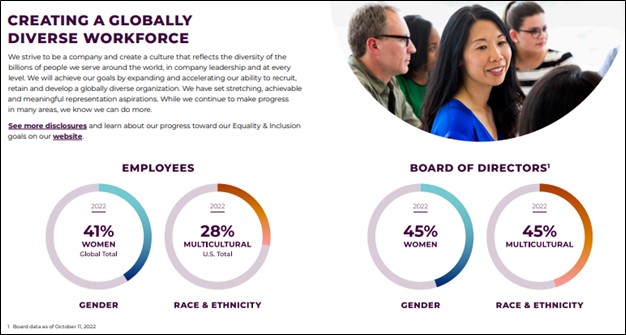
Image Source: P&G’s Citizenship Report
P&G has also been active in supporting Ukrainian families during the war, providing “millions of everyday essentials, including diapers, shampoo, toothpaste, toothbrushes, and other cleaning, health and hygiene products to people displaced from their homes.” P&G strives to create a globally diverse workforce, with 41% of employees being women and 28% multicultural, as of 2022. Its board of directors is also diverse with 45% women and 45% multicultural.
As it relates to climate, the company has “set a new ambition to achieve net zero greenhouse gas (GHG) emissions across (its) operations and supply chain, from raw material to retailer by 2040.” With respect to waste, P&G is “working to design all of “its consumer packaging to be recyclable or reusable by 2030.” The company also has goals to restore more water than it consumes at manufacturing sites in nearly two dozen water-stressed areas around the world.
Concluding Thoughts
Procter & Gamble’s fiscal fourth quarter disappointed a number of investors as organic growth failed to outpace expectations. Looking to fiscal 2025, all-in sales growth is expected in the range of 2%-4%, with organic growth in the range of 3%-5%. P&G is targeting fiscal 2025 core net earnings per share growth in the range of 5%-7% versus fiscal 2024 core earnings per share of $6.59. We like P&G a lot, but shares are trading well above our fair value estimate.
—–
NOW READ: What to Do During This Market Selloff
Brian Nelson owns shares in SPY, SCHG, QQQ, DIA, VOT, RSP, and IWM. Valuentum owns SPY, SCHG, QQQ, VOO, and DIA. Brian Nelson’s household owns shares in HON, DIS, HAS, NKE, DIA, RSP, SCHG, QQQ, and VOO. Some of the other securities written about in this article may be included in Valuentum’s simulated newsletter portfolios. Contact Valuentum for more information about its editorial policies.
Valuentum members have access to our 16-page stock reports, Valuentum Buying Index ratings, Dividend Cushion ratios, fair value estimates and ranges, dividend reports and more. Not a member? Subscribe today. The first 14 days are free.