
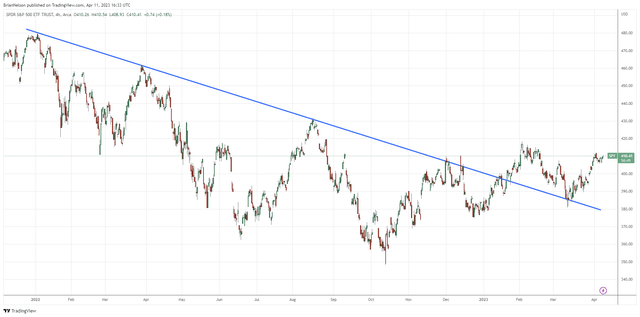
Image: The market-capitalization weighted S&P 500 (SPY) continues to hold its January breakout, while support held in mid-March.
By Brian Nelson, CFA
Though the regional banking crisis in the U.S. remains on investors’ minds, the panicky environment that has defined much of the past couple months has settled down somewhat, even as First Republic Bank’s (FRC) back remains against the ropes. The regional bank has suspended the dividends on several series of its preferred stock, and we’re hearing of advisor flight from the bank as it now appears to be fighting a consumer perception battle as it struggles to stay afloat.
First Republic is clearly on the front lines of the regional bank crisis, and if the bank holds the line so to speak, we think it becomes more probable that any further crisis stemming from the collapse of SVB Financial (SIVB) may be stymied. The massive held-to-maturity (HTM) portfolio of unrealized losses across the regional banking sector may make the space largely “un-investable,” however. We’ve never really been fans of the banking business model. Taking on leverage to lend, while failing to hold sufficient cash to meet deposits isn’t exactly an attractive proposition, in our view.
That said, the market-capitalization weighted S&P 500 is no longer in a downtrend, and while the regional banking crisis gave investors pause, we’d have to say the markets don’t look bad. From a technical standpoint, the SPY broke through its downtrend in January, while it held support in mid-March. If the S&P 500 can break through the early February near-term highs, technically, things are looking quite good for the beginnings of this nascent market leg-up. It’s been a long road to get to what looks like a “bottom,” but we might have witnessed it in October of last year.
Fundamental risks remain, however. Even though the regional banking crisis in the U.S. has faded somewhat into the background, its impact on consumer lending has likely been meaningful, and that may have had an impact on economic activity the past few months. The commercial real estate market, particularly office space, remains a big question mark as the work-from-home trend has a touch of permanence to it. For one, instead of coming into the office 5 days a week, perhaps 3 or 4 days may be the new norm for workers. Executives may be sorting through how to optimize office space under such conditions. More dividend cuts may be coming for office REITs. The war raging in Ukraine, and UBS Group’s (UBS) purchase of Credit Suisse (CS) are two dynamics that could spell trouble for Europe, while geopolitical tensions continue to rise between the U.S. and China.
S&P 500 earnings remain under pressure, too. FactSet estimates that the decline for S&P 500 earnings may reach 7% for the first quarter of 2023, which is a rather big step back on a year-over-year basis. Inclusive of expectations for a rough first-quarter 2023 earnings season, the forward 12-month P/E ratio stands at 18.0, which may be considered lofty compared to the 10-year average, but not unreasonable in light of a 10-year Treasury rate that has fallen to 3.4% from north of 4% in October of last year. Though big cap tech and large cap growth may not be the cheapest on the market, we’re huge fans of their massive cash-based sources of intrinsic value–net cash on the books and future expected free cash flow.
We’re waiting to see how the regional banks fare when they report first-quarter 2023 numbers soon, and how the S&P 500 acts technically in the near term before “re-deploying” newly-raised capital in the newsletter portfolios. Banking crises tend to take time to work themselves out, and while things have calmed down a bit since SVB Financial’s seizure, we’re not losing sight of the massive unrealized losses on the books of many regional banks, and the ultra-competitive nature of the banking business model, a dynamic that could mean the bigger banks get bigger and many smaller regional banks continue to struggle. In any case, we continue to steer clear of banking equities, more generally, with only very small exposure in the Best Ideas Newsletter portfolio via the Financial Select SPDR (XLF).
Tickerized for FRC, SIVB, SPY, UBS, CS, RSX, MCHI, FXI, KWEB, KRE, KBE, TLT, VGLT, AGG, BND, IEI, BLV, RSP, ARE, KRC, BXP, DEA, FSP, CMCT, CUZ, HPP, OPI, BDN, OFC, PGRE, SLG, ESRT, EQC, HIW, PDM, NYC, XLF
———-
Brian Nelson owns shares in SPY, SCHG, QQQ, DIA, VOT, BITO, RSP, and IWM. Valuentum owns SPY, SCHG, QQQ, VOO, and DIA. Brian Nelson’s household owns shares in HON, DIS, HAS, NKE, DIA, and RSP. Some of the other securities written about in this article may be included in Valuentum’s simulated newsletter portfolios. Contact Valuentum for more information about its editorial policies.
Valuentum members have access to our 16-page stock reports, Valuentum Buying Index ratings, Dividend Cushion ratios, fair value estimates and ranges, dividend reports and more. Not a member? Subscribe today. The first 14 days are free.