
By Brian Nelson, CFA
We like Realty Income Corp. (O) a lot, but it’s not hard to see that the REIT could potentially have all the makings of a black swan. For one, the stock is loved by almost everyone–REIT investors, income investors, and dividend growth investors alike. Many are simply enamored by its monthly dividend, which it has raised nearly 120 times since it was listed on the NYSE in 1994. Over its 54-year history, the REIT has paid 632 consecutive monthly dividends, too.
There’s a ton of things to like about Realty Income, but for this note, let’s build and examine the bear case, one that can be broken into three pillars: 1) its retail exposure, 2) its financial leverage and arguably unwarranted investment-grade credit rating, and 3) the current rising interest rate environment. Somewhat counterintuitively, we view evaluating where Realty Income investors could go wrong as a helpful exercise to support a bullish view on the REIT’s shares.
Retail Exposure
First, let’s cover the obvious: retail exposure. Walgreens Boots Alliance (WBA) and 7-Eleven are two of its top clients, consisting of more than 7% of annualized contractual rent. AMC Theaters (AMC), which may very well be headed toward bankruptcy in the coming years in the event that direct-to-consumer streaming services continue to proliferate, accounts for ~1.5% of its business. In the U.S., Walgreens is becoming a largely redundant franchise, at least when it comes to groceries and other items, while 7-Eleven, despite a strong track record of same-store sales growth, seems like a very, very tired brand. The “apes” of AMC may keep the firm’s theaters alive for some time, too, but trends haven’t been favorable to theaters these days. Long-term dynamics seem to be working against a meaningful portion of Realty Income’s annualized contractual rent, and its portfolio remains heavily levered to Dollar General (DG), which we recently removed from the Best Ideas Newsletter portfolio.
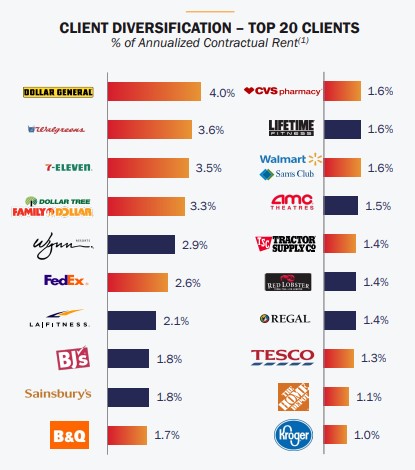
Image Source: Realty Income
Financial Leverage and an Arguably Unwarranted Investment-Grade Credit Rating
Next up is Realty Income’s financial leverage. At the end of 2022, the REIT’s net debt to annualized pro forma adjusted EBITDAre was 5.3x. The rating agencies give Realty Income lofty investment-grade credit ratings of A3/A-, but we wonder if any company that is leveraged north of 5x, with very little cash on hand, and one that is required to pay out most of its earnings as dividends can ever be a strong credit. Realty Income only receives about ~41% of its rent from investment-grade credits, too.
We’re just not sure that a company with so much leverage, with so little cash, with customers that lack investment-grade marks themselves can have such a high credit rating. Further, if we take Realty Income at its word and use its own long-term WACC calculation of 6.7%, then capitalizing its ~$1.8 billion cash distributions to shareholders implies a present value of future dividend liabilities of $26.9 billion (assuming no growth in the payout).
Roughly $17.76 billion in net debt on the balance sheet and $26.9 billion in present-value future dividend liabilities and only $2.56 billion in annual operating cash flow during 2022, a measure that considers no capital investments of any sort. Realty Income could be viewed as built merely on a mountain of net debt and future expected dividend liabilities. It could easily be said that something’s not quite adding up when it comes to its investment-grade credit rating.
Rising Interest Rates
Rising interest rates are wreaking havoc across the REIT sector these days, with major REIT indices now trailing the broader stock market for a very long time. Realty Income’s forward estimated dividend yield of ~5% is only slightly better than that of a one- to two-year certificate of deposit at the bank, and that of the U.S. 2-year Treasury, too.
That Realty Income has a fantastic dividend growth track record is one thing, but its yield now matches that of risk-free government-backed financial instruments. It’s also not hard to see that much of Realty Income’s expansion has rested on the back of its investment-grade credit rating, which, in our view, isn’t really supported by its operating cash flow relative to its massive net debt and the present value of its future expected dividend liabilities.

Image: REITs have not performed as well as one might have thought. Source: Vanguard
Concluding Thoughts
It’s helpful to challenge one’s thesis on a favorite idea every now and then, and we’ve done just that with Realty Income in this article. We see three areas of weakness at Realty Income that could challenge our bullish take on the name: 1) its retail exposure, 2) its financial leverage and arguably unwarranted investment-grade credit rating, and 3) the current rising interest rate environment. Perhaps the most compelling component of the bear case on Realty Income is its massive net debt position and present value of future dividend liabilities that dwarf its annual operating cash flow. The REIT business model isn’t as attractive as many make it out to be.
NOW READ: Why Are the Dividends of REITs So Risky?
NOW READ: The Impact Rising Interest Rates Have on Equity REITs
NOW READ: How the Payment of a Dividend Impacts Intrinsic Value Estimation
NOW READ: REITs May Continue to Face Pressure
———-

Brian Nelson owns shares in SPY, SCHG, QQQ, DIA, VOT, BITO, RSP, and IWM. Valuentum owns SPY, SCHG, QQQ, VOO, and DIA. Brian Nelson’s household owns shares in HON, DIS, HAS, NKE, DIA, and RSP. Some of the other securities written about in this article may be included in Valuentum’s simulated newsletter portfolios. Contact Valuentum for more information about its editorial policies.
Valuentum members have access to our 16-page stock reports, Valuentum Buying Index ratings, Dividend Cushion ratios, fair value estimates and ranges, dividend reports and more. Not a member? Subscribe today. The first 14 days are free.