
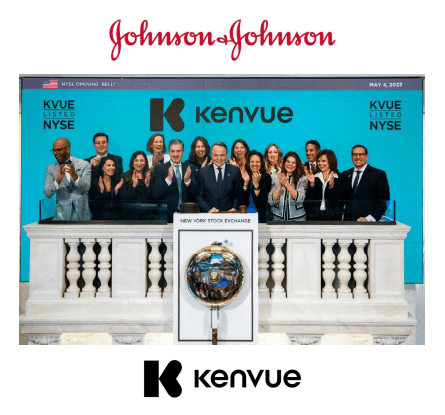
Image Source: Johnson & Johnson
By Brian Nelson, CFA
Johnson & Johnson (JNJ) recently entered the “too hard” bucket for us. We dropped J&J from the Best Ideas Newsletter portfolio and Dividend Growth Newsletter portfolio on March 13 of the year, as we lost interest in the company given the uncertainties surrounding talc liabilities and the Kenvue (KVUE) split-off. We prefer simplicity across our newsletter portfolios, and J&J’s results have often been messy, to say the least.
Though J&J’s second-quarter 2023 performance, released July 20, was a bit better, we no longer have much interest in the name, given its net debt position and contingent talc liabilities. We’re also not interested in shares of its split-off Kenvue, having completely removed J&J from the newsletter portfolios prior to the split. On July 24, J&J launched an exchange offer:
Johnson & Johnson today announced its intention to split-off at least 80.1% of the shares of Kenvue Inc. through an exchange offer. Kenvue, formerly Johnson & Johnson’s Consumer Health business, completed its initial public offering in May 2023. Through the planned exchange offer, Johnson & Johnson shareholders can exchange all, some or none of their shares of Johnson & Johnson common stock for shares of Kenvue common stock, subject to the terms of the offer. The exchange offer is expected to be tax-free for U.S. Federal income tax purposes.
Shares of Johnson & Johnson are up a meager 2% so far in 2023 in one of the biggest bull-market runs that we’ve seen in a while. Over the past month, shares of Kenvue Inc. have declined more than 5%. We maintain our prior opinion and believe it was the right move to remove J&J from the newsletter portfolios in March of this year. Whether J&J shareholders should exchange all, some, or none of their J&J shares for Kenvue shares may not be the right question, but rather whether investors have sufficient exposure to the areas of big cap tech and large cap growth.
We continue to believe the strongest areas of the market will remain big cap tech and large cap growth for the foreseeable future. Many of the current stock-market leaders, including Apple (AAPL), Alphabet (GOOG) (GOOGL) and Microsoft (MSFT), have tremendous cash-based sources of intrinsic value, with net cash overflowing on their balance sheets as they generate free cash flow that is several times that of J&J’s. In J&J’s second-quarter 2023 results, for example, free cash flow came in at ~$5.4 billion. This mark was $19.8 billion for Microsoft and $21.8 billion for Alphabet during the same calendar quarter, by comparison.
J&J/Kenvue are great companies, but they just don’t make the cut for the newsletter portfolios.
NOW READ: J&J Reports Messy Q4, Free Cash Flow Remains Robust But Looming Kenvue Split Adds Uncertainty
NOW READ — Questions for Valuentum’s Brian Nelson
NOW READ — ALERT: Big Yield Additions to Dividend Growth Newsletter Portfolio and High Yield Dividend Newsletter Portfolio
NOW READ — ALERT: Going to “Fully Invested” in the Best Ideas Newsletter Portfolio
NOW READ — Expect Huge Equity Returns This Decade, Much More Volatility However
NOW READ — There Are No Free ‘Income’ Lunches
———-

Brian Nelson owns shares in SPY, SCHG, QQQ, DIA, VOT, BITO, RSP, and IWM. Valuentum owns SPY, SCHG, QQQ, VOO, and DIA. Brian Nelson’s household owns shares in HON, DIS, HAS, NKE, DIA, and RSP. Some of the other securities written about in this article may be included in Valuentum’s simulated newsletter portfolios. Contact Valuentum for more information about its editorial policies.
Valuentum members have access to our 16-page stock reports, Valuentum Buying Index ratings, Dividend Cushion ratios, fair value estimates and ranges, dividend reports and more. Not a member? Subscribe today. The first 14 days are free.