
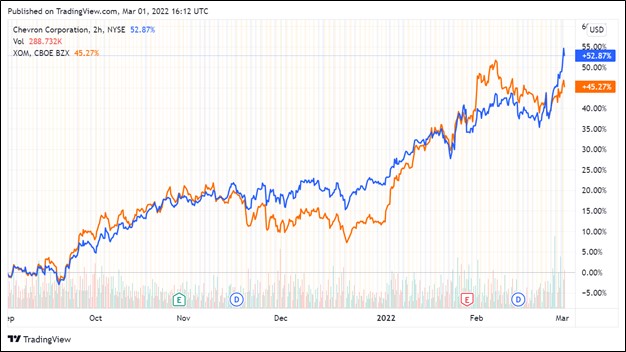
Image Shown: Shares of Chevron Corporation (blue line) and Exxon Mobil Corporation (orange line) have skyrocketed over the past six months.
By Callum Turcan
In the wake of Russia invading Ukraine (again) in February 2022, geopolitical tensions between the West and Russia have reached levels last seen during the height of the Cold War. At the beginning of March 2022, near term WTI and Brent futures were trading north of $100 per barrel while liquified natural gas (‘LNG’) spot prices and European natural gas prices remained incredibly expensive. The supply-demand dynamics for crude oil and natural gas were already tight before this crisis, and in light of the expansive sanctions programs enacted by the West and some of its allies on Russia in wake of its ongoing invasion of Ukraine, the chance that energy flows out of Russia to Europe and the rest of the world could moderate has sent raw energy resources pricing sharply higher.
We covered our thoughts on this issue and how it is driving energy prices higher in our latest Valuentum Weekly (link here), which we strongly encourage our members to check out if you have not already done so. As we stated in our Valuentum Weekly, we hope peace prevails in the end. However, things are currently looking quite dire, and the humanitarian situation is deteriorating. Russian forces are descending on major Ukrainian cities across the country, and it appears the worst of the fighting has yet to begin. Again, we hope peace prevails in the end and that a humanitarian catastrophe can be avoided.
How Recent Events Impact Western Energy Giants
Chevron Corporation (CVX) and Exxon Mobil Corporation (XOM), our two favorite large cap energy firms included as ideas in the newsletter portfolios, have relatively modest exposure to Russia. Peers such as BP plc (BP) and Shell plc (SHEL) have publicly stated that they would effectively abandon their stakes in Russian operations, and there is a decent chance Chevron and Exxon Mobil will follow suit.
For BP, that involved recently announcing it would divest its 19.75% equity stake in the state-run oil giant Rosneft (OJSCY) along with its joint ventures with Rosneft in Russia through a move that will incur a massive write-off. At the end of 2021, BP’s Rosneft stake had an ~$14 billion carrying value along with ~$11 billion in accumulated foreign exchange losses relating to that stake. The three joint ventures in Russia between BP and Rosneft had a carrying value of ~$1.4 billion at the end of 2021.
BP acquired the Rosneft equity stake back in 2013 through a deal that saw BP sell off its stake in TNK-BP (a Russian energy firm) as part of a portfolio simplification strategy announced in 2012. Additionally, both BP-nominated board members recently resigned from Rosneft’s board. BP expects to take a material non-cash charge as a result of these measures in the first quarter of this year. It is unlikely BP will be able to sell its Rosneft equity stake for a reasonable price in the current geopolitical environment.
For Shell, the firm recently announced it was exiting its joint ventures with the state-run Russian gas giant Gazprom (OGZPY). That includes its 27.5% stake in the large Sakhalin-II liquified natural gas (‘LNG’) export terminal in Russia’s Far East region, its 50% stake in the Salym Petroleum Development, 50% stake in the Gydan energy venture, and ending its participation in the Nord Stream 2 natural gas pipeline development (runs under the Baltic Sea from Russia to Germany). Shell’s press release noted that:
At the end of 2021, Shell had around $3 billion in non-current assets in these ventures in Russia. We expect that the decision to start the process of exiting joint ventures with Gazprom and related entities will impact the book value of Shell’s Russia assets and lead to impairments.
These are material write downs and represent Western energy giants forgoing sizable cash dividends and distributions from their operations in Russia, especially in the current raw energy resources pricing environment, to comply with the rapidly evolving geopolitical situation on the ground.
Chevron and Exxon Mobil
Looking at Chevron, the company has relatively modest direct exposure to Russia. Chevron owns 15% of the Caspian Pipeline Consortium (‘CPC’), which operates a massive 900+ mile long crude oil pipeline that runs from Kazakhstan in Central Asia through Western Russian to the Russian port of Novorossiysk along the Black Sea with the ability to transport well north of one million barrels of crude oil per day. Exxon Mobil is also an investor in the CPC and owns 7.5% of the venture. We caution that entities affiliated with the Russian government are major investors in the CPC as well.
In Kazakhstan, Chevron owns a 50% stake in Tengizchevroil (‘TCO’) which operates the massive Tengiz oil field and the smaller Korolev oil field. Exxon Mobil owns 25% of the TCO venture, which produced 26.6 million metric tons of crude oil (equivalent to over 190 million barrels of oil) according to the TCO venture’s website. Additionally, the TCO venture is actively expanding production at the Tengiz oil field, and please note that all the crude oil produced by the TCO venture was routed to export markets through the CPC last year.
Should the operations of the CPC get negatively impacted by the Ukraine-Russia crisis, that could have a meaningful impact on the production levels of Chevron and Exxon Mobil in Kazakhstan and an immense impact on global energy markets. Chevron noted that in 2021, the CPC carried an average of 1.3 million barrels of crude oil per day, 1.1 million of which came from Kazakhstan with the remaining 0.2 million barrels coming from Russia. The capacity of the CPC is being expanded to support expected production growth at the TCO venture, and should these expansion efforts get negatively impacted, that would also have a significant impact on global energy markets given the size of the expansion and the lack of spare production capacity elsewhere.
Chevron also owns 18% of the Karachaganak gas condensate field in Kazakhstan. Most of the liquids (crude oil and condensate) produced by that field was exported by the CPC last year. Expansion activities at the Karachaganak field are currently underway. Losing the ability to utilize the CPC would have a major impact on Chevron’s and Exxon Mobil’s operations in Kazakhstan, which is currently not directly a part of the Russia-Ukraine crisis though we caution Kazakhstan’s current regime is seen as an incredibly close ally of Russia.
Pivoting to Exxon Mobil, other than its aforementioned stakes in the CPC and the TCO venture, the firm also owns a ~17% stake in Kazakhstan’s Kashagan oil field along with other assets in the country. Production from the Kashagan oil field is also routed to global markets via the CPC.
In Russia, Exxon Mobil participates in the Sakhalin-1 oil and gas project in the country’s Far East region through its Exxon Neftegas Limited subsidiary, the operator of the endeavor, and owns 30% of this development. This operation was expected to supply the proposed Russia Far East LNG export project which Exxon Mobil was taking the lead on, though it is now quite unlikely that this development will get the green light anytime soon from the Sakhalin-1 consortium (at least in its current form).
Back in 2018, in the wake of US and EU sanctions on Russia, Exxon Mobil officially withdrew from its former joint ventures with Rosneft (which were established before 2014, when Russia invaded Ukraine and annexed Crimea). This reduced Exxon Mobil’s direct exposure to Russia to a degree. Exxon Mobil also markets lubricants in Russia via independent distributors and licenses some of its refining, gas, and chemical technologies in the country with an eye towards petrochemical operations. At the end of 2021, Exxon Mobil had $4.1 billion in long-lived assets based in Russia on its books (out of $216.6 billion in net PP&E and $338.9 billion in total assets).
Concluding Thoughts
Should Chevron be forced to part ways with Russia, that would have a marginal impact on the company given that it does not have any meaningful direct exposure to the country. However, should Chevron’s stake in CPC and its ability to do business with the CPC get negatively impacted in any way, that would be quite material as that would negatively impact its Kazakhstan operations in a big way. Without access to the CPC, exporting crude out of Kazakhstan becomes an incredibly difficult task. As of this writing, we do not expect this will be the case given that the CPC consortium primarily caters to Kazakhstan’s export needs and is owned by a wide array of investors, though everything appears to be on the table as it concerns sanctions packages.
For Exxon Mobil, the company does have some direct exposure to Russia and would lose the ability to proceed with the Far East LNG export development should it be forced to part ways with Russia. However, its exposure to Russia is relatively modest for a company of its size, and Exxon Mobil has been shifting its resources elsewhere in recent years such as towards projects in the US, Guyana, and Brazil. As it concerns Exxon Mobil’s exposure to Kazakhstan and the CPC, that remains an important consideration, though again we do not expect Western governments will force Chevron or Exxon Mobil to divest their stake in CPC and cease doing business with the pipeline operator.
We are keeping a close eye on this rapidly evolving situation. Shares of CVX and XOM have boomed higher in recent months, and we continue to like both large cap energy firms as ideas in our newsletter portfolios.
—–
Oil and Gas Complex Industry – BKR, HAL, SLB, BP, CVX, COP, XOM, RDS (now SHEL), TOT, COG, EOG, OXY, PXD, ENB, ET, EPD, MMP, KMI, PSX
Related: SHEL, OJSCY, OGZPY
Tickerized for BNO, E, HES, RDS.A, RDS.B, USO, XLE, XES, XOP, VLO.
Valuentum members have access to our 16-page stock reports, Valuentum Buying Index ratings, Dividend Cushion ratios, fair value estimates and ranges, dividend reports and more. Not a member? Subscribe today. The first 14 days are free.
Callum Turcan owns shares in FB and XLE and is long call options on FB and XLE. Energy Select Sector SPDR Fund ETF (XLE) is included in Valuentum’s simulated Best Ideas Newsletter portfolio. Chevron Corporation (CVX) and ExxonMobil Corporation (XOM) are both included in Valuentum’s simulated Best Ideas Newsletter portfolio, simulated Dividend Growth Newsletter portfolio, and simulated High Yield Dividend Newsletter portfolio. Enterprise Products Partners L.P. (EPD) and Magellan Midstream Partners L.P. (MMP) are both included in Valuentum’s simulated High Yield Dividend Newsletter portfolio. Some of the other companies written about in this article may be included in Valuentum’s simulated newsletter portfolios. Contact Valuentum for more information about its editorial policies.