
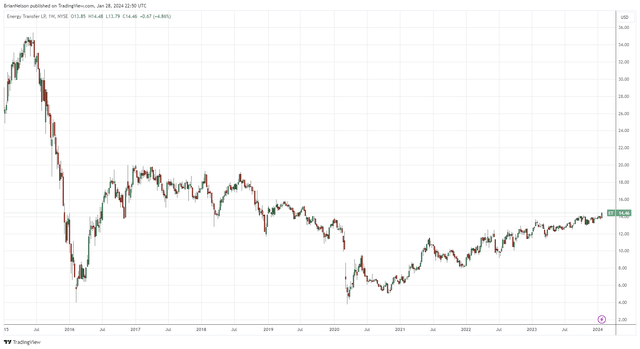
Image: Energy Transfer is working its way back after a long stretch of underperformance.
By Brian Nelson, CFA
Energy Transfer (ET) is one of the largest midstream, transportation and storage companies for natural gas, crude oil, NGLs (natural gas liquids), and other refined products, and the firm has investments in Sunoco LP (SUN) and USA Compression Partners (USAC). The company is nowhere near the bubble levels of 2015, but the pipeline operator has been staging a comeback backed by traditional free cash flow, and we are warming up to this dividend payer. Shares yield ~8.7% at the time of this writing.
In the pipeline space, investors tend to pay attention to a metric called distributable cash flow [DCF], not to be confused with discounted cash flow, which is used in the enterprise discounted cash flow valuation process that we use at Valuentum. What we think is most important to focus on is traditional free cash flow, as measured by cash flow from operations less all capital spending. This measure of free cash flow is a great way to evaluate the financial health of a company’s dividend.
On this front, things have improved considerably at Energy Transfer. Cumulatively, during the past three fiscal years, Energy Transfer has generated ~$27.57 billion in operating cash flow and has spent ~$11.33 billion on capital expenditures, translating into ~$16.24 billion in traditional free cash flow. Distributions to partners and noncontrolling interests over this time period totaled ~$12.4 billion, meaning that Energy Transfer is doing a much better job meeting distribution obligations with traditional free cash flow (and by a sizable margin).
In 2022 alone, cash flow from operations totaled ~$9.05 billion, while capital expenditures were $3.38 billion, resulting in traditional free cash flow of ~$5.67 billion, which was well in excess of the ~$4.59 billion it paid out in distributions to partners and noncontrolling interests over the same time period. Energy Transfer has continued this trend into 2023, too. Through the first nine months of the year, free cash flow was ~$5.82 billion, greater than the ~$4.41 billion it paid out in distributions to partners and noncontrolling interests over the same time period.
On January 25, Energy Transfer raised its dividend modestly, by 0.8%, to $0.315 per share on a quarterly basis, and while Energy Transfer still has a massive net debt position to the tune of ~$47.6 billion, the firm’s traditional free cash flow of the payout suggests sustainability, absent any exogenous shocks. Standard & Poor’s recently upgraded its unsecured debt rating to BBB with a Stable outlook, and the firm’s capital spending guidance for 2023 was recently lowered, further helping free cash flow. Energy Transfer is staging a comeback, and for risk-seeking income investors, its ~8.7% dividend yield is worth a look.
—–
NOW READ: 12 Reasons to Stay Aggressive in 2024
NOW READ: 2023 Was a Fantastic Year! Are You Ready for 2024?
Brian Nelson owns shares in SPY, SCHG, QQQ, DIA, VOT, RSP, and IWM. Valuentum owns SPY, SCHG, QQQ, VOO, and DIA. Brian Nelson’s household owns shares in HON, DIS, HAS, NKE, DIA, RSP, SCHG, QQQ, and VOO. Some of the other securities written about in this article may be included in Valuentum’s simulated newsletter portfolios. Contact Valuentum for more information about its editorial policies.
Valuentum members have access to our 16-page stock reports, Valuentum Buying Index ratings, Dividend Cushion ratios, fair value estimates and ranges, dividend reports and more. Not a member? Subscribe today. The first 14 days are free.