
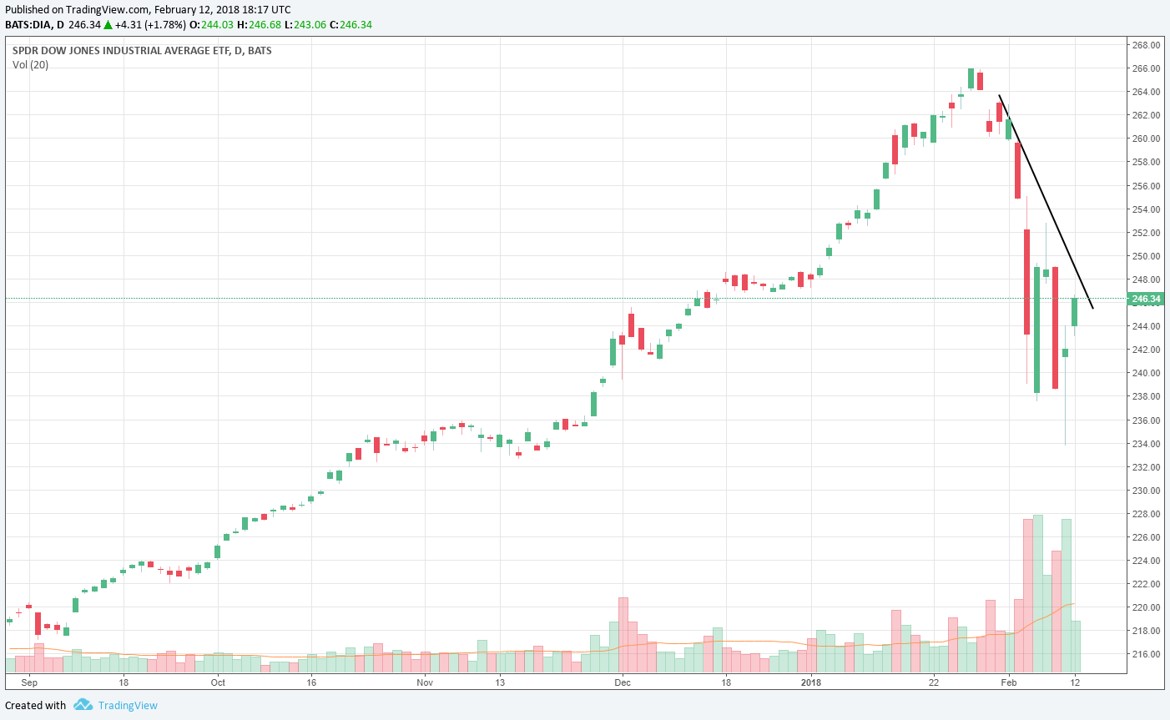
Image shown: The performance of the Dow Jones Industrial Average since September 2017.
The market continues to lick its wounds following the sell-off. We’re watching interest rates and technicals for signs where the market may go next.
By Kris Rosemann and Brian Nelson, CFA
The US 10-year Treasury yield (TLT, TBT) hit a four-year high before the open February 12, suggesting recent volatility in the equity markets is anything but going away in the near term, despite stocks bouncing back from the rough week that ended February 9. Rising interest rates may not create a financial crisis, but it could challenge the widely-held view that stock prices only increase over long-enough periods of time. After all, the past 40-year bull market has witnessed the federal funds rate fall to practically 9% from 20% previously. According to Bloomberg, the SPDR S&P 500 ETF (SPY), the world’s largest passive fund by assets under management, experienced a record $23.6 billion in outflows (~8% of total assets, the highest rate of exits since August 2010) in the trading week ended February 9. Inflation-related data, which is worth watching as it relates to potentially accelerated interest rate hikes, is scheduled to be released February 14.
However, crude oil (USO, OIL) prices are benefiting from positive demand projections from OPEC after languishing alongside the recent volatility in stocks. In its most recent monthly report, released February 12, the group raised its world oil demand expectations for 2018 by 1.59 million barrels per day (bpd) thanks to the health of the global economy, which it expects to continue in the near term. OPEC also raised its projections for global oil supply by 1.4 million bpd due in part to increasing activity in US shale and offshore deep-water production. An increase in production expectations has led to lower global requirements for OPEC-produced oil in the year, but the group still expects global oil markets to return to balance towards the end of 2018 as inventories continue to decline.
President Trump’s highly-anticipated infrastructure spending plans were updated on February 12 as the administration aims to stimulate $1.5+ billion in new investment while shortening project permitting time to two years and investing in rural projects and worker training. Please read the full fiscal 2019 budget report here (pdf). Streamlining of environmental reviews and consolidation of certain energy project approval is sure to face pushback from environmental groups. Other budget cuts that will be pursued to free up funding (a key consideration given the impact recent tax reform will have on federal revenue) are likely to face headwinds as well. The plan includes $200 billion in federal spending that is designed to incentivize state and local governments and private companies to account for the remaining promised investments. US infrastructure-related stocks (PAVE) are on the move higher following the news.
Broadcom (AVGO) has made another step forward in its attempted takeover of Qualcomm (QCOM) as it has secured as much as $100 billion in debt financing. The acquisition would be the largest tech takeover of all time, and securing adequate funding could remove a meaningful contention point for the hostile $121 billion offer. Qualcomm has stated that the bid undervalues the company, but it plans to meet with Broadcom to address “serious deficiencies in value and certainty in its proposal.” The fight has meaningful implications beyond the fate of Qualcomm itself as consolidation within the wireless technology equipment sector is pursued to mitigate the negotiating power dominant smartphone producers such as Apple (AAPL) and Samsung (SSNLF) have flexed of late in keeping chip prices low.
In other political news, the White House is reportedly planning to stop funding the International Space Station after 2024 as it develops a transition plan to turn the station over to the private sector. Boeing (BA) currently operates the station for NASA for approximately $3-$4 billion per year, and supply flights are already being carried out by SpaceX and Orbital ATK (OA). However, international agreements may make such a proposition quite difficult to carry out.
Infrastructure-related companies: CAT, DE, AGCO, VMC, AKS, NUE, CX, VMC
Engineering & Construction: ACM, CBI, EME, FLR, GVA, JEC, KBR, LAYN, MDR, PWR
—–
Valuentum members have access to our 16-page stock reports, Valuentum Buying Index ratings, Dividend Cushion ratios, fair value estimates and ranges, dividend reports and more. Not a member? Subscribe today. The first 14 days are free.
Kris Rosemann and Brian Nelson do not own shares in any of the securities mentioned above. Some of the companies written about in this article may be included in Valuentum’s simulated newsletter portfolios. Contact Valuentum for more information about its editorial policies.