
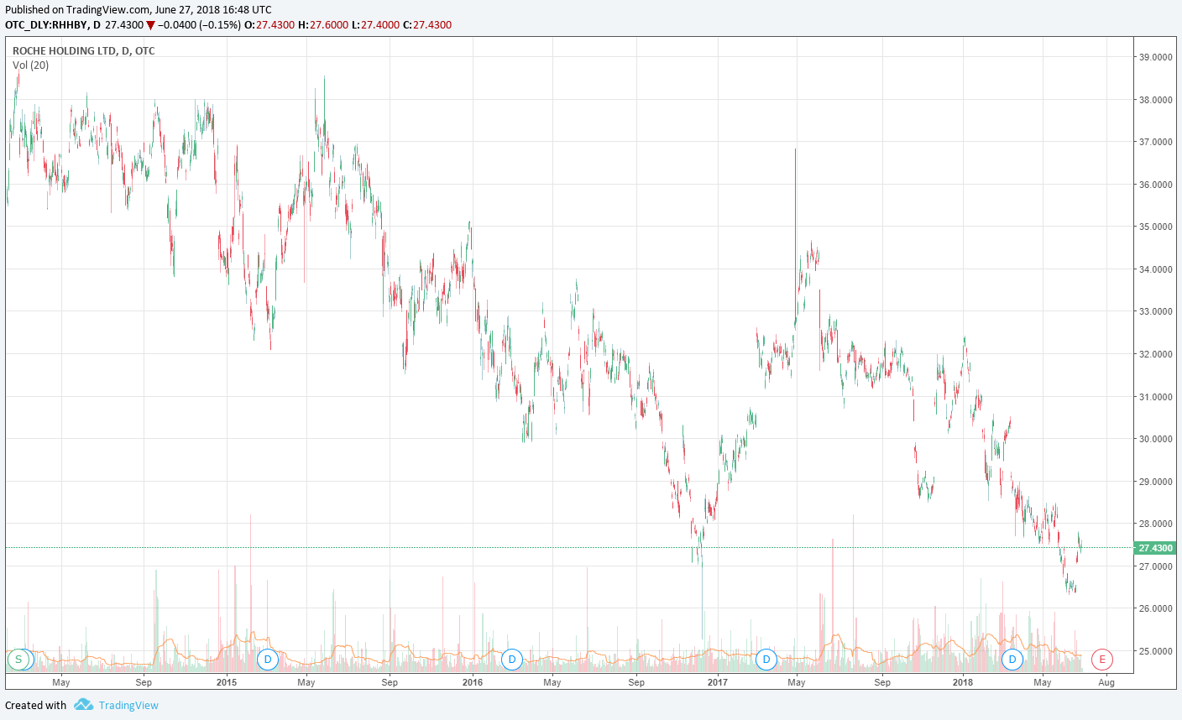
We like cutting-edge, novel therapies as they have a transformative impact on a small to mid-cap biotech as years of revenue growth could be in the cards. While new therapies are the life-blood of the research field, the impact of a new novel therapy on the growth prospects of a large cap is often muted, however. Such is the fate of Roche as it struggles to replace its mainstay oncology division with new patent-protected entities.
By Alexander J. Poulos
Key Takeaways
Roche remains highly exposed to loss of patent exclusivity as a whole suite of its top-producing products is expected to lose coverage over the next couple of years.
Roche will need to hit a few home runs, but its best shot a PD-L1 treatment dubbed Tecentriq keeps posting underwhelming data.
We continue to like Novartis as a dividend growth idea, as Roche seems poised to continue to underwhelm on a fundamental basis, in our view.
The Looming Patent Cliff
Roche (RHHBY) is facing the daunting task of having to replace the revenue of its two top-selling products Rituxan and Herceptin, both of which combine account for over 30% of its overall pharmaceutical sales. Rituxan remains Roche’s top-selling product, but the product is expected to lose US patent protection by year-end 2018. The European patent coverage has already lapsed with Roche reporting a drop of 11% in top-line sales for this segment. We underscore the initial drop could be mild as widespread adoption of a more cost-effective biosimilar may follow the drop in revenue witnessed in the oral dosage formulations once a patent lapse.
We would not be surprised if the company experiences an 80% drop in revenue through year five of patent loss which, would equate to over 4 billion CHF (Swiss Frac) in lost sales from this product alone. To add further context, sales of $1 billion would confer blockbuster status to a product. Roche would need a string of four to stay in place. Roche has been fortunate thus far, as the US FDA has rejected numerous biosimilar applications, but we view this as a temporary setback. We fully expect an approval will arrive shortly, thus allowing significant cost savings to accrue for the US healthcare system.
The outlook for Herceptin is just as precarious as the treatment has generated over 7 billion CHF, just under the 7,388 billion CHF generated by Rituxan. A biosimilar has won approval in the US thus paving the way for quick US adoption once the patent protecting Herceptin lapses in 2019. To the credit of Roche’s management team, they have not sat idle, however, as they have proactively sought out new treatments to offset the enormous looming patent cliff.
Tecentriq to the Rescue?
Roche has pinned the bulk of its hope in the immune-oncology space with its novel PD-L1 treatment Tecentriq. Roche is angling for Tecentriq to steal some of Merck’s (MRK) star performer Keytruda in a battle for immune-oncology supremacy.
In our view, we remain unimpressed with the data posted from Tecentriq thus far, as it appears the PD-L1 target is less effective than Keytruda’s PD-1. Let’s compare some of the data recently posted in the all-important non-small cell lung cancer cohort, the key area where former pole setter Bristol-Myers Squibb (BMY) Opdivo disapppointed. The less-than-stellar result by Opdivo has placed a pall on the share price of Bristol, as the equity has failed to scale the previous high nearly two years after the initial shock of disappointing clinical data.K eep in mind the S&P 500 (SPY) is up over 20% in the same time frame, underscoring the tremendous underperformance of Bristol following the trial failure in August of 2016.
Roche has made an initial splash with a press release stating its IMpower130 trial combining Tecentriq with chemotherapy has met its primary and secondary endpoint in the treatment of non-squamous small cell lung cancer. The full results will be unveiled at an upcoming oncology trial, which gives some hope to investors in Roche. Roche did reveal some data on its IMpower 131 trial, which compared Tecentriq and chemo to the results shown with chemo alone for the treatment of squamous non-small cell lung cancer.
Tecentriq did meet its primary endpoint of progression-free survival, but the combination did not exceed the results of median overall survivability data, where the combo posted 14 months versus 13.9 months with chemo alone. We will await the full disclosure of the IMpower 130 data read, but our initial thoughts are that the results will likely underwhelm, in-line with the underwhelming data posted by other PD-L1 treatments.
Roche plans to continue funding numerous clinical trials to bring forth the full potential of Tecentriq, but we believe the PD-L1 treatments will be proven to be an inferior target, thus opening the door from Merck and to a lesser extent Bristol-Myers and a late-to-the-party charge by Regeneron (REGN) to more than likely dominate the field.
Role of Roche’s Dividend
In our view, the main appeal of Roche centers on the annual dividend of $1.08 per ADR for a current yield ~4%. We do not view Roche as an appealing investment consideration from a “best ideas” perspective due to the underwhelming clinical data, and this combined with its looming patent cliff leave Roche highly exposed to a decline in revenue. From a dividend growth perspective, we are not fans of this well-run pharma giant as we continue to view Novartis (NVS) as the better idea.
To add further context to our generation cautious stance on shares of Roche, the equity has an unenviable track record with ADR’s managing to post a generally weak 10-year return in the midst of one of the best bull runs in recent memory. As a fair comparison, Novartis’ track record is better which we attribute to a more-proactive management team coupled with a better-diversified portfolio, lessening the impact of inevitable patent losses. In the case of Roche, the company may become increasingly challenged to offset the looming patent cliff and may resort to costly bolt-on acquisitions, reducing the company’s ability to shoulder a lofty dividend burden.
Conclusion
We remain unimpressed with Roche as the less-than-overwhelming data posted by its key asset keeps us on the sidelines. We are hard-pressed to construct a plausible scenario where Roche will be able to grow top-line sales over the next few years, and a loss of patent exclusivity may continue to weigh on sentiment, and by extension, the share price. Roche may have to resort to costly M&A activity, too, which could weaken the balance sheet, limiting dividend sustainability and growth potential. With Roche headquartered in Switzerland, the effect of a stronger US dollar may depress the overall value of the divided, too, which further dampens the appeal of the company.
—–
Valuentum members have access to our 16-page stock reports, Valuentum Buying Index ratings, Dividend Cushion ratios, fair value estimates and ranges, dividend reports and more. Not a member? Subscribe today. The first 14 days are free.
Heathcare and biotech contributor Alexander J. Poulos does not own shares of companies mentioned in this article. Some of the companies written about in this article may be included in Valuentum’s simulated newsletter portfolios. Contact Valuentum for more information about its editorial policies.