
Image Source: kibbles_bits
By Alexander J. Poulos
Earnings Release
We have written a few bearish pieces on biotech stalwart Amgen (AMGN) this year. In the first piece, “The Dreaded Patent Cliff: 3 Pharmaceutical Companies at Risk,” we presented a number of areas of concern, most notably the expected drop in revenue from Amgen’s two main products. In its first-quarter earnings release, issued April 26, Amgen posted earnings per share of $3.15 on a non-GAAP basis versus $2.90 for the same period last year. Upon first glance, the numbers would indicate solid growth, but upon further examination, a worrisome trend emerges. The “earnings beat” is a direct result of a decrease in expenses and a lower share count, as top line revenue declined 1%.
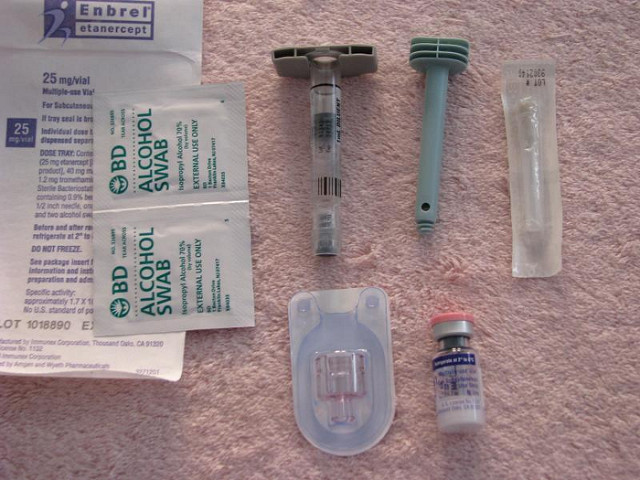
Our cautiousness on Amgen’s equity is supported by top-selling product Enbrel posting a disturbing product sales drop of 15% as compared to the prior period. Enbrel has the unenviable task of having to compete in the suddenly-crowded field of inflammatory disease. Underscoring our concern is the recent loss of patent protection in Europe combined with volume loss in the US and pricing concerns. The competitive landscape is similar for Neulasta, a neutrophil stimulator. Neulasta is prepping for a biosimilar challenge, which could eat into market share. To the credit of Amgen’s management team, however, it is attempting to migrate patients to the ONPRO system, which is patent protected. Neulasta posted a tepid 2% revenue growth in the quarter on a year-over-year basis, and we believe expansion will reverse in the coming quarters, putting additional pressure on Amgen’s pipeline to make up for lost revenue.
Near-Term Pipeline
Amgen has spent a considerable sum in the field of cardiovascular disease, a large and growing market, but one that will require a differentiated product to garner a significant share. Amgen has pinned its hope on Repatha, a PCSK9 treatment for hypercholesterolemia. Uptake thus far remains tepid as the enormous price tag has limited the utilization of the product. Amgen is optimistic the recent release of outcomes data would lower payer resistance. In a recent article dubbed, “Analyzing Amgen’s Sudden Fall,” Repatha lowered overall cholesterol, but missed on the crucial endpoint of reducing cardiac death which would have cast aside the barriers erected by payers.
The share price of Amgen had ran up on the enthusiasm of the yet-to-be-released full details of the clinical results. The market had bid the shares up on the headline that the Fournier trial achieved its primary endpoint, with Amgen’s stock price eclipsing $184 for a brief moment on March 15. The initial enthusiasm, however, has since worn off, post the full clinical trial results, as the share price has given up nearly the entirety of the gains for 2017.
The second product in Amgen’s pipeline with multi-billion dollar promise is Evenity, a humanized monoclonal antibody for the treatment of osteoporosis. Expectations are running high for the product, but the optimism, too, came to a screeching halt. Amgen reported a cardiac signal that was not present in the FRAME study, a rather unfortunate turn of events as Evenity met its primary and secondary endpoints for the reduction of fractures in the recently completed ARCH study. The finding comes as a bit of a shock, as Amgen and its co-development partner UCB do not expect approval of Evenity in the US this year. The adverse cardiac reading will delay approval while potentially permanently impairing the commercial viability of the product. The setback in Evenity removes another key peg from Amgen’s near-term pipeline.
The final compound in the near-term pipeline of note, in our view, is Erenumab, a monoclonal antibody for the treatment of migraine headaches. Amgen is co-developing the product with Novartis (NVS), which in our view, limits the overall impact on Amgen’s revenue. Eli Lilly (LLY) recently posted data of its own monoclonal antibody dubbed Galcanezumab, with a similar side-effect profile. We expect that the initial price tag of each monoclonal antibody will be steep, thus setting the stage for PBM’s to post a host of roadblocks limiting the initial uptake. With little to differentiate the two products, we envision a scenario where significant price concessions will be needed in order to gain formulary placement. We would not be at all surprised if the initial uptake mirrors Repatha, which in our view, remains a huge disappointment for Amgen shareholders thus far.
Biosimilar Aspirations are Not a Panacea
Amgen continues to push for a presence in the biosimilar space, a puzzling move in our opinion. Amgen does not have a dedicated generic drug arm such as the Sandoz division that is housed under the Novartis corporate umbrella. In essence, Amgen is creating a new specialized division that will carry lower margins than its proprietary drug division. We view the biosimilar field through the same lens as the solid dosage forms marketed by firms such as Teva (TEVA) and Mylan (MYL). Both Teva and Mylan are attempting to diversify from their generic roots into higher-margin branded products with mixed results. The generic drug market continues to face a deflationary headwind–we would not be at all surprised if the biosimilar “gold rush” follows the same fate. We believe Amgen would be far better served devoting the resources to R&D in an attempt to find new novel treatments instead of attempting to make a cheaper version of another company’s product.
Conclusion
We just can’t get excited with Amgen at the moment. Shares remain stuck in the $140-$160 range with very brief short-lived forays above the range. As discussed above, the lack of a meaningful pipeline catalyst coupled with competitive challenges in its top two products continues to plague the bullish case for Amgen. While the dividend is interesting, we feel Best Ideas Newsletter portfolio member Johnson and Johnson (JNJ) remains the better choice as Amgen continues to work through its challenges.
Disclosures: Healthcare and biotech contributor Alexander Poulos is long Novartis and Eli Lilly.