

No changes to newsletter portfolios.
By Kris Rosemann
Reports of a potential trade agreement between the US and China (FXI) have hit the wire. The deal is rumored to include lower Chinese tariffs on farm, chemical, auto, and other US products, and the elimination of many or all US tariffs on Chinese products. China is also reportedly exploring a 3% reduction in the value-added tax it imposes on manufacturing, which could provide a 0.6% boost to Chinese GDP, according to some estimates. Both reports are welcome news to investors as concerns over global economic growth persist. A US-China trade deal could be announced as soon as the end of this month, but the recent breakdown in conflict resolution talks between the US and North Korea has some observers taking a cautious approach to the news.
Despite the optimism surrounding reportedly constructive US-China trade talks, weaker than expected construction spending in the US in the month of December added fuel to the notion that the US economy was losing steam at the tail end of 2018. Consensus estimates, according the Reuters, for construction spending in the month came in at an increase of 0.2%, but the reported figure fell 0.6% on a sequential basis. Other areas of less-than-ideal economic data from the month of December include retail sales, housing starts, trade, and home sales. While mortgage rates may be plateauing, higher costs of building materials and land and labor shortages could continue to impact the housing market.
Meanwhile, lower demand from China has impacted a variety of businesses, including chemicals companies amid suppressed demand growth, perhaps most notably in China. This has been coupled with companies such as DowDuPont (DWDP) and Exxon Mobil (XOM) adding capacity in recent years in attempts at taking advantage of natural gas as a low-cost feedstock. According to ICIS, a petrochemical market information service, the price in China of high-density polyethylene, which serves as a benchmark for similar plastics, has fallen 18% from its peak in the summer of 2018.
Increased short-term demand for natural gas due to domestic weather conditions could impact the relative attractiveness of shale gas as a feedstock for plastics, and China could become a more notable buyer of US natural gas should a trade deal be finalized. Shares of DowDuPont are currently trading just below our fair value estimate of $56 each.
Vale Facing Potential $7 Billion Fine
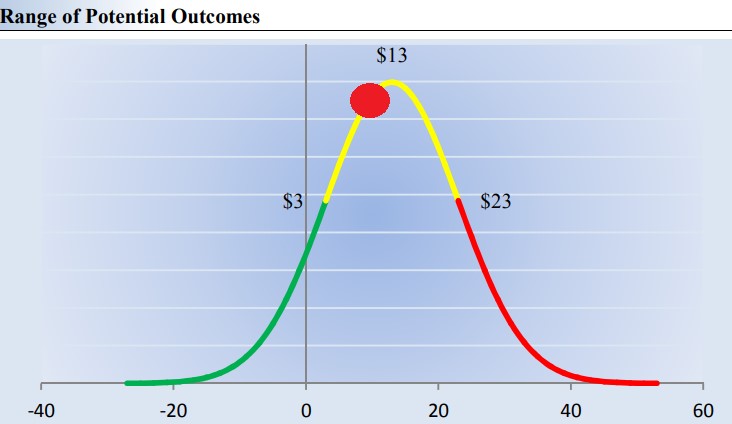
Image shown: The red dot denotes where shares of the company are trading. If it falls on the green part of the fair value estimate distribution, we think shares are undervalued. If it falls on the yellow part of the fair value estimate distribution, we think shares are fairly valued, and if it falls on the red part of the fair value estimate distribution, we think shares are overvalued (as of the time of this publishing).
Iron ore giant Vale (VALE) could face a fine of close to $7 billion, according to the Wall Street Journal, if it is ultimately convicted of hiding dangerous conditions related to its recently collapsed dam. A similar disaster at the company’s joint venture Samarco Mineracao in 2015 brought a $5.3 billion fine. Shares are currently trading roughly in-line with our fair value estimate, but investors should note the wide fair value range that we assign. One-time costs will likely be notable, but the long-term implications on ongoing operations has yet to be seen.
Philip Morris (PM) Lowers 2019 Earnings Guidance
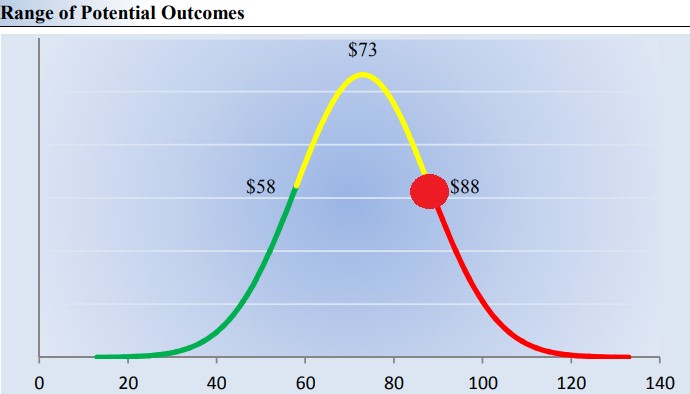
Image shown: The red dot denotes where shares of the company are trading. If it falls on the green part of the fair value estimate distribution, we think shares are undervalued. If it falls on the yellow part of the fair value estimate distribution, we think shares are fairly valued, and if it falls on the red part of the fair value estimate distribution, we think shares are overvalued (as of the time of this publishing).
Philip Morris lowered its guidance for 2019 reported diluted earnings per share to at least $5.28 from previous guidance of at least $5.37 per share. The reduction is due to an increase in pre-tax tobacco litigation-related expenses, which is the result of a judgement in two class action lawsuits in Quebec. Adjusted diluted earnings per share came in at $5.10 for the company in 2018, but the adjustment highlights the increasingly challenging regulatory and legal environment facing tobacco companies. Shares are trading near the upper bound of our fair value range as of this writing.
Updated 12:11CT March 4, 2019.
—–
Valuentum members have access to our 16-page stock reports, Valuentum Buying Index ratings, Dividend Cushion ratios, fair value estimates and ranges, dividend reports and more. Not a member? Subscribe today. The first 14 days are free.
Kris Rosemann does not own shares in any of the securities mentioned above. Some of the companies written about in this article may be included in Valuentum’s simulated newsletter portfolios. Contact Valuentum for more information about its editorial policies.