
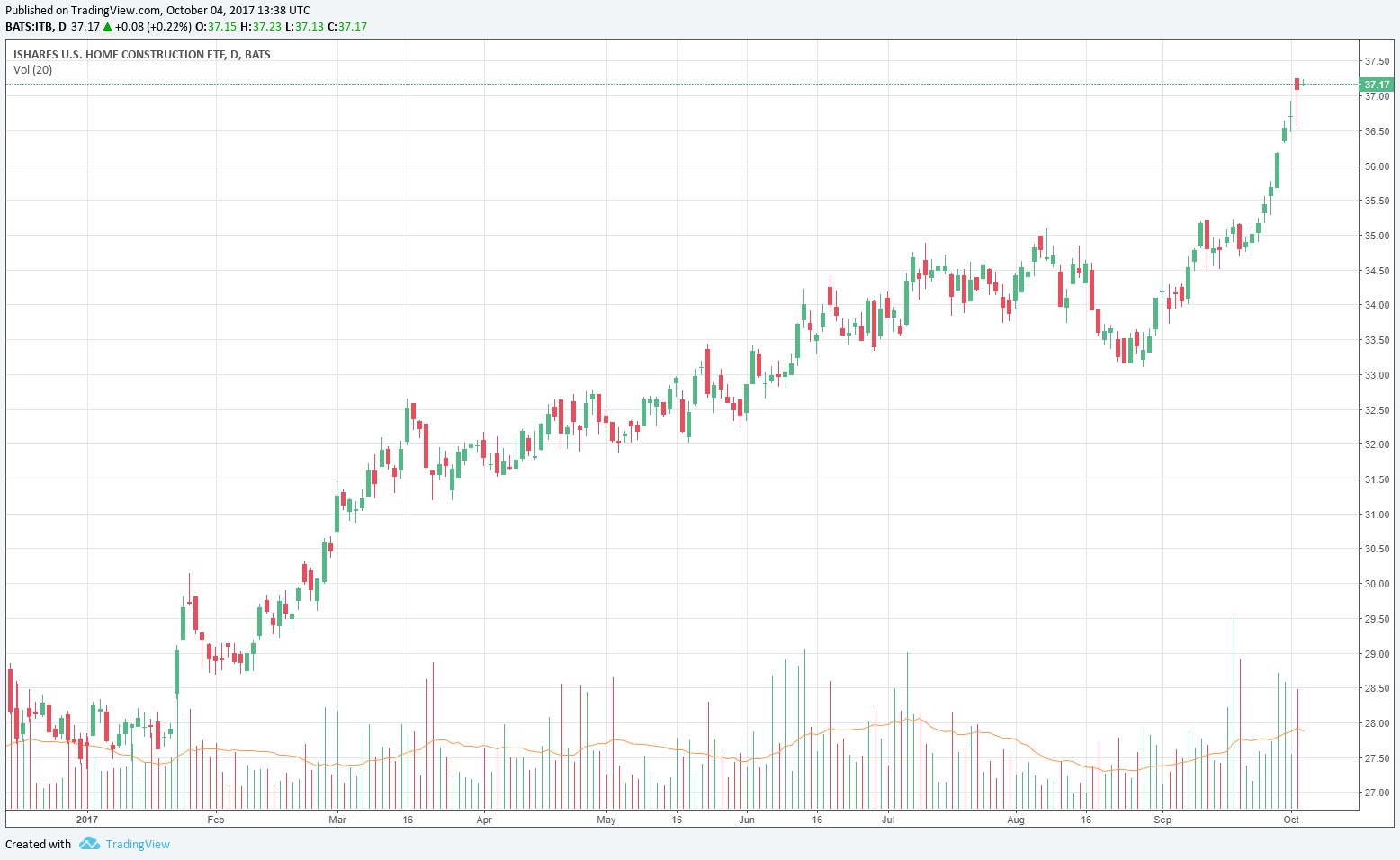
Image Shown: The iShares US Home Construction ETF (ITB) has advanced ~ 24% year-to-date, according to data from YahooFinance.
“Housing indicators may be leveling off,” per S&P Corelogic, and the threat of rising interest rates looms (as it has for years), but we like the fundamental strength that we’re seeing from the homebuilders of late, which has translated into strong equity performance.
By Brian Nelson, CFA
We’ve been bullish on the US housing market recovery since early 2012, and we’ve pointed to several factors as to why–including improved affordability, investment by both individuals and investors, falling unemployment, improved household formation, limited inventory, and more recently, the wealth effect that a rising stock market provides. Things continue to be on the up-and-up with housing, too. The latest readings on the S&P CoreLogic Case-Shiller Indices, for example, showed that “as of July 2017, average home prices for the MSAs within the 10-city and 20-city Composites are back to their winter 2007 levels,” a period of time just prior to the worst of the Financial Crisis. Inventory stands at about 6.1 months.
While housing prices appear to be recovering nicely in most major markets, new residential sales (seasonally adjusted annual rate), however, came in a little light for the month of August, that report released September 26. This is just the latest monthly reading, and the measure may move around a bit throughout the year, so we’re not reading too much into it. What we think is most important, however, is that the pace of new residential sales is ~50% higher than levels in 2012 (source: US Census Bureau, HUD). The level of sales continues to be good news, from where we stand, but the July S&P Corelogic Case-Shiller Home Price Index, released September 26, offered a couple contradicting thoughts we thought important to share:
Home prices over the past year rose at a 5.9% annual rate…Consumers, through home buying and other spending, are the driving force in the current economic expansion. While the gains in home prices in recent months have been in the Pacific Northwest, the leadership continues to shift among regions and cities across the country. Dallas and Denver are also experiencing rapid price growth. Las Vegas, one of the hardest hit cities in the housing collapse, saw the third fastest increase in the year through July 2017.
While home prices continue to rise, other housing indicators may be leveling off. Sales of both new and existing homes have slipped since last March. The Builders Sentiment Index published by the National Association of Home Builders also leveled off after March…The housing market will face two contradicting challenges during the rest of 2017 and into 2018. First, rebuilding following hurricanes across Texas, Florida and other parts of the south will lead to further supply pressures. Second, the Fed’s recent move to shrink its balance sheet could push mortgage rates upward.
Though the outlook for housing could be considered mixed given the contradicting challenges noted above, a few recent data points have been quite encouraging. Lennar’s (LEN) third-quarter results, for example, released October 3, revealed that the builder’s deliveries advanced 12%, new orders increased 14%, while its backlog jumped 15%. The company’s gross margin improved 20 basis points, and its operating margin improved 40 basis points, both arguably a reflection of the better housing price environment, as Lennar noted that in the third quarter, revenue benefited from a “4% increase in the average sale price of homes delivered.” Lennar’s CEO Stuart Miller offered some solid commentary backing up the healthy backdrop for housing:
We are pleased to announce our third quarter results as we achieved net earnings of $249.2 million, or $1.06 per diluted share. These results were supported by strong demand for homes, low unemployment, favorable interest rates and increased consumer confidence which are all signs of a very healthy homebuilding market.
Just a few days prior to Lennar’s quarterly release, KB Home (KBH) put up a nice quarterly report of its own. During the three months ended August 31, deliveries at KB Home advanced 11%, while net order value grew 15%. Backlog leapt 14%, and the company noted that the average selling price advanced 12%. KB Home’s cancelation rate as a percentage of gross orders also improved to 25% from 29%. We’re now more than 8 years past the March 2009 panic bottom of the Financial Crisis, which may speak to an aging recovery, but the homebuilders continue to put up strong performance in key metrics. KB Home CEO Jeffrey Mezger had the following to say about third-quarter results:
We posted double-digit increases in revenues and earnings, and generated measurable improvement across our key financial metrics. Significantly, we increased our housing gross profit margin on a year-over-year basis, excluding inventory-related charges, and we expect to sustain this favorable comparison on a quarterly basis going into 2018. In addition, with the expansion in our gross margin and a record-low third quarter SG&A ratio, we improved our operating income margin by 100 basis points, extending the upward trend in this important profitability measure… We believe we are well positioned as we move into the closing months of our fiscal year, with a backlog value of more than $2 billion and positive conditions in most of our served markets.
All things considered, “housing indicators may be leveling off,” per S&P Corelogic, and the threat of rising interest rates looms (as it has for years), but we like the fundamental strength that we’re seeing from the homebuilders of late, which has translated into strong equity performance. For example, the iShares US Home Construction ETF (ITB), which lists DR Horton (DHI), Lennar, NVR (NVR), PulteGroup (PHM) and Toll Brothers (TOL) as its top 5 holdings, has advanced ~24% year-to-date, according to data from YahooFinance. In our view, the ITB is a reasonable, diversified idea if readers expect the US housing markets to continue to their robust recovery. We’re watching the iShares US Home Construction ETF very closely for consideration in the Best Ideas Newsletter portfolio.
Tickerized for stocks in the ITB.
Related: XHB