
Tickerized for holdings in the XLV and IBB.
Cystic Fibrosis is a rare disease that afflicts an estimated seventy-five thousand patients worldwide. Vertex Pharmaceuticals is the first to market with a combination treatment to treat a portion of the overall patient population. Will Vertex win the race to bring forth a triple therapy to treat the vast majority of those afflicted?
By Alexander J. Poulos
Cystic fibrosis (CF) is a recessive genetic disorder. The patient that is afflicted will carry two copies of the cystic fibrosis conductance regulator protein (CFTR) gene. The CFTR gene allows the body to produce the CFTR protein, whose function is to remove chloride from the cells. Patients that have CF will suffer from a “thickening” of the body’s secretions (mucus, saliva, tears and digestive enzymes). The thickening of mucus is especially burdensome; the patient will become prone to respiratory infections. Patients will frequently experience congestion with a cough often associated with it.
CF is a disease that afflicts the very young, according to the Cystic Fibrosis Foundation; 75% of those afflicted will be diagnosed by the age of 2. CF symptoms will become progressively worse as the patient ages, with most not reaching the fourth decade of life. Life expectancy has improved in recent years, but the need for additional treatments remains. The following quote from Vertex sums up the grim prognosis for those afflicted with CF.
“Today, the median predicted age of survival for a person with CF is between 34 and 47 years, but the median age of death remains in the mid-20s.”
Vertex Pharmaceuticals
Vertex Pharmaceuticals (VRTX) is a research-based biotech entity with a near-term pipeline focused on combinations to treat CF. Vertex does have two products that are approved for the treatment of CF, but the overreliance on one disease state poses an additional layer of risk for equity holders. A recent example from Vertex’s past illustrates the danger. Vertex believed with the approval of Invicek (which treats HCV), the company would be able to transform itself fundamentally. Vertex thought it would make the quantum leap from a profitless upstart to a mid-stage biotech with an attractive pipeline.
Vertex was ill prepared for the “creative disruption” that was about to be unleashed into the HCV marketplace, however. Pharmasset released compelling initial data for Sofosbuvir, what proved to be the clinical backbone used to effectively “cure” HCV. Vertex failed to act in a proactive manner to defend its HCV franchise. Instead, it stood idle as Gilead Sciences (GILD) swooped in an aggressively purchased Pharmasset.
With the rights to Sofosbuvir secure, Gilead would go on to dominate the HCV marketplace, while Vertex would have to remove Invicek from the market due to lack of demand. Vertex lacked the foresight to protect its franchise; in the span of fewer than four years, the product transformed from a potential blockbuster to off the market.
Kalydeco
Vertex’s lead product for the treatment of CF is Kalydeco (Ivacaftor), a CFTR potentiator. Kalydeco works by allowing the “gates” that enable the removal of chloride from the cells to remain open longer. The theory is by enabling the “gates” to stay open longer, the patient will clear chloride in a more rapid manner. The patient population that is afflicted with CF has a defective gene that regulates this process. The concept of Kalydeco is an excellent first step in the treatment process, but additional combination therapies will be needed to bring relief to the vast majority of those afflicted with CF. Vertex estimates it is receiving reimbursement for 4,000 patients that are treated with Kalydeco. The overall worldwide patient population is estimated at 75,000 patients. The need for combination therapies to treat the vast majority of patients remains largely unmet.
Orkambi
Vertex initial foray into combination therapy is Orkambi (Ivacaftor/Lumacaftor) which was approved in 2015. The mechanism of action for Lumacaftor (corrector) is to allow for additional defective F508del-CFTR proteins to reach the outer surface of the cells. When combined with Ivacaftor’s ability to allow for the enhanced clearing of chloride, the combination treatment should improve the overall removal of chloride. With approval for the F508del mutation, Orkambi has expanded the eligible patient population that can be treated with the product to 25,000 patients.
There are potential drawbacks to the promise of combination therapy in CF. Challenges remain with the overall widespread adoption of Orkambi. The primary reason is the side effect profile of the medication. The most prevalent side effect is dyspnea, a particularly troublesome adverse event in the CF population. Dyspnea as a general definition is difficulty in breathing. A patient with dyspnea may suffer from shortness of breath or wheezing. With a decrease in overall lung function from CF, many have discontinued use of Orkambi. The need for additional correctors with a more favorable side effect profile remains. Fortunately for Vertex bulls, Tezacaftor seems poised to replace Lumacaftor as the corrector of choice going forward.
Tezacaftor
Vertex retains its lead in attempting to bring forth a combination therapy to expand the eligible patient population. While Lumacaftor is a positive first step, due to its side effect profile, it would not make an ideal candidate for inclusion in triple therapy. Vertex needs to bring forth a more potent corrector while minimizing the side effect profile. We view Tezacaftor as an important pivot that should allow Vertex to focus on triple therapy.
Vertex announced results from recently concluded clinical trials for Tezacaftor. The primary endpoint of the study was statistically significant in improvements in lung function (percent predicted forced expiratory volume in one second), or ppFEV1. The combination of Tezacaftor/Ivacaftor demonstrated an increase of 3.4% versus a decrease of 0.6% in the placebo arm. As a comparison, the ppFEV1 for Orkambi is 2.8% from the pooled data of the Traffic and Transport studies that were used to gain FDA approval.
While the increase in ppFEV1 is impressive, the key to the commercial success of the product rests in the adverse events experienced while using the therapy. Tezacaftor’s primary side effects are infective pulmonary exacerbations, cough, and headache. The side effect profile is similar to the data from the placebo group, which is a positive for Tezacaftor. Based on the results from the trial, Vertex plans to file for approval in the US and Europe in the third quarter of 2017.
Revenue
Vertex reported annual CF revenues of $1.683 billion in 2016. Revenue jumped 71% as Vertex recognized a full year of Orkambi sales in 2016. Vertex issued initial CF revenue guidance of $1.79-2.01 billion for 2017 as reimbursement authorization continues to hamper overall growth. Vertex estimates that 13,000 of the 25,000 of the eligible patient population is not receiving Orkambi.
The main hold up is over the reimbursement level for the treatment. For example, in Germany, the German Federal Joint Committee announced a compensation agreement effective December 16, 2016 after the product demonstrated “considerable additional benefit.” Orkambi was approved for use in November 2015. The holdup in reimbursement is illustrative of the challenge Vertex faces when negotiating with foreign governments.
Due to the costly, chronic nature of the treatment, however, Vertex will continue to face intense scrutiny over the value of the treatment.
Profitability
Vertex reported a loss of $0.46 per share in 2016 on a GAAP basis as R&D costs continue to hamper profitability. Vertex guided GAAP R&D and SG&A expenses of $1.55-1.7 billion in 2017 versus 1.48 billion in 2016. The primary reason for the increase in costs is Vertex’s aggressive funding of R&D in its quest for a triple therapy. We believe the market is overlooking the cost burden faced by Vertex to gain worldwide reimbursement for its products. The 13-month delay in Germany is emblematic of the challenges faced by Vertex. For example, utilizing the same timetable of 13 months for Orkambi reimbursement, Tezacaftor/Ivacaftor would not receive payment approval until sometime late in the first quarter of 2019. Our estimates are based on a Q3 2017 new drug application filing and a six-month review before approval.
Vertex is expected to release phase two data of the next generation corrector in the second half of 2017. Assuming a favorable side effect profile, Vertex would choose the most potent corrector to combine with Tezacaftor/Ivacaftor in the long-awaited triple therapy. We estimate the second half of 2018 data read to account for the time it takes to recruit eligible patients and gain the necessary steps to conduct a clinical trial. The product would be fast-tracked yet we estimate it would take nearly a year for final approval accounting for the time it takes Vertex to complete the application and for the respective authorities to approve the product. We are now looking at a mid-2019 marketing approval, which is important from a patent point of view.
The patent for Ivacaftor, the clinical backbone of the therapy expires in Europe (the largest overall market) in 2025 and the US in 2027. The Tezacaftor patent expires in the US in 2027 and 2028 in Europe. We can not understate the importance of the patent life. With each therapy, an oral dosage form the loss of patent protection would devastate future profitability. With cost containment the highest priority in healthcare, we expect robust generic competition, but not for some time yet. We do view the diverse patient population as a bit of a challenge but we believe financial implications will win out in the end. Vertex will eventually have to dramatically reduce prices to retain share which will hamper the overall profitability of the company, but this may not happen for years.
Future Competition
Currently, Vertex has a commanding lead in the area of CF, but additional players have entered the market. To Vertex credit, the company is reducing the risk of creative disruption and is proactively looking to defend the CF franchise. We applaud the move to purchase CTP-656 from Concert Pharmaceuticals (CNCE). CTP-656 is an investigational cystic fibrosis transmembrane conductance regulator (CFTR) potentiator.
We believe Vertex paid a steep yet necessary price of $160 million in cash for all worldwide development and commercialization rights to CTP-656. If Vertex can gain approval of the product, an additional $90 million in milestones based on regulatory approval in the US and reimbursement in the UK, Germany or France would be paid to Concert. Vertex has removed a competitive threat in CTP-656, and it seems management has learned from its HCV fiasco.
Outlook
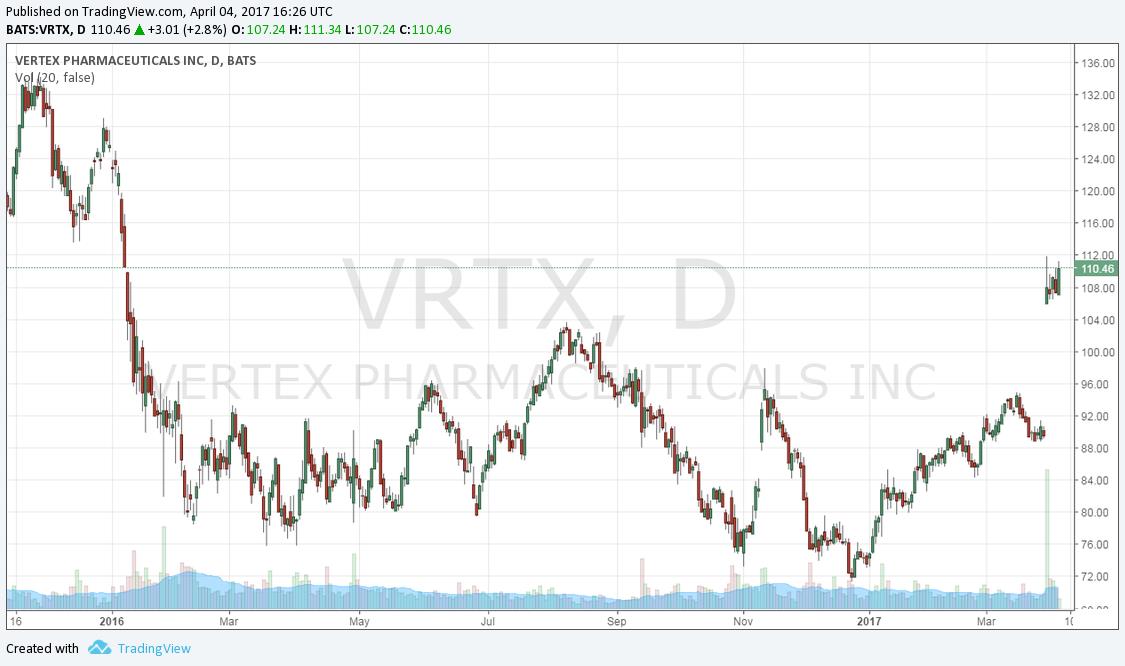
Shares of Vertex jumped nearly 20% on the positive results of Tezacaftor/Ivacaftor. We feel the run up may be overdone, and we continue to watch shares. Mainly, we are put off by the near $27 billion dollar market cap of the company and weak near-term earnings visibility.
That said, we do feel Vertex CF therapies are currently the best in class, but significant earnings growth remains elusive. The lack of significant short-term profits reduces the potential for the company to become an acquisition target, too. Big pharma remains awash in cash, with notable holes in its product pipeline, but we believe the junior biotechs with market caps less than $10 billion remain the most suitable acquisition targets, far easier to swallow that Vertex.
Let’s keep an eye on this one.
Tickerized for holdings in the XLV and IBB.