
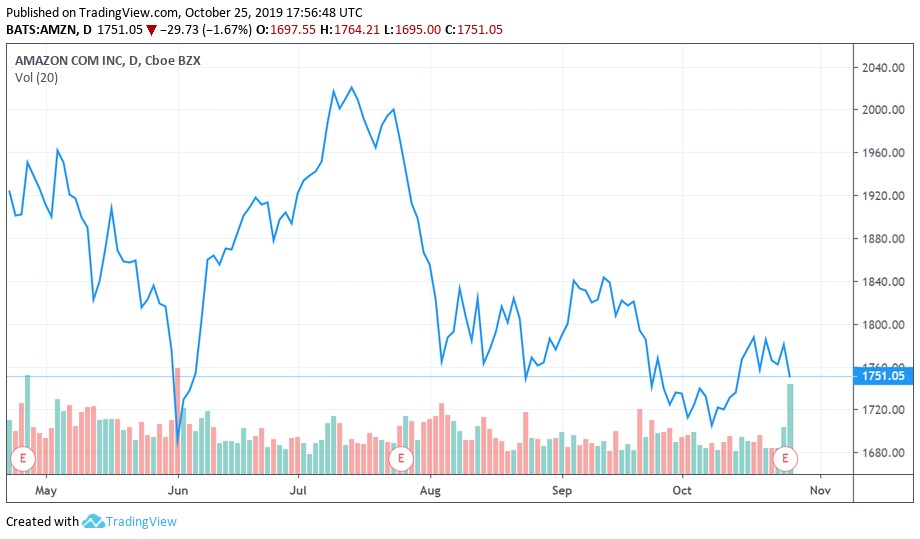
Image Shown: Shares of Amazon Inc have stumbled so far in 2019 as the headwinds from rising tariffs, largely a product of the US-China trade war, combined with a competitive cloud computing landscape put downward pressure on its profitability levels.
By Callum Turcan
Amazon (AMZN) reported third quarter 2019 earnings after the market close on Thursday October 24 that underwhelmed investor expectations and saw shares plummet after-hours. However, shares of AMZN recovered somewhat throughout the trading session on Friday October 25. While GAAP revenues climbed 24% year-over-year to $70.0 billion in the third quarter, GAAP operating income declined 15% year-over-year to $3.2 billion due in part to rising operating expenses (growth in marketing, technology and content, and G&A expenses outpaced revenue growth) and declining gross margins. Amazon’s GAAP gross margin fell by ~70 basis points year-over-year during the third quarter as tariffs began to take their toll, with an eye towards the US-China trade war. Effectively, Amazon isn’t passing along (all of the) cost inflation to its customers in a bid to preserve its dominance in the US e-commerce market and elsewhere.
Quarterly Overview
In North America, Amazon’s net sales grew 24% year-over-year in the third quarter, but expenses grew at a faster rate, driving its operating income from this geographical segment lower 37% year-over-year, to $1.3 billion. On the international front, Amazon’s net sales grew by 18% year-over-year and its operating loss stayed broadly flat at $0.4 billion (operating income of negative $0.4 billion). AWS, Amazon Web Services, continued to perform well with net sales up 35% year-over-year allowing for its operating income from this segment to shift higher by 9% to $2.3 billion.
It’s very important to note that rising operating expenses at AWS (up 46% year-over-year) combined with growing competitive threats from other cloud computing providers (putting pressure on Amazon’s pricing abilities) led to Amazon’s cloud segment, its main source of operating income, to underwhelm in the third quarter in terms of profitability. The company is making big investments in the future of cloud computing to support AWS’ promising growth trajectory, but that will in effect cause Amazon’s income generation to miss market expectations at times. During the firm’s quarterly conference call with investors, Amazon’s CFO Brian Olsavsky noted that:
“…our margins expectations are that we will price competitively and continue to pass along pricing reductions to customers both in the form of absolute price reductions and also in the form of new products that will in effect cannibalize the old ones. And we also see a point out that you know increasingly what we’re doing is renegotiating or negotiating incremental price decreases for customers who then commit to us long term. And if you look at our disclosure on our 10-Q, it shows that we have $27 billion in future commitments for AWS, from AWS customers and that’s up 54% year-over-year. So that’s another thing to watch, it’s not only the short-term commitment, but also the long-term commitment that we see.”
Rising AWS operating expenses during the third quarter came from increases in marketing budgets and major infrastructure investments in anticipation of rising usage from both existing and new customers. Management mentioned that this trend would continue into the fourth quarter, indicating that rising operating expenses will likely consume a good chunk of Amazon’s incremental AWS operating profit going forward (at least in the short-term). We would like to highlight that, while this strategy will lead to short-term volatility in the tech and e-commerce giant’s financial performance, these cloud computing investments are a good way to generate long-term shareholder value, in our view.
Financial Update
At the end of September 2019, Amazon was sitting on $23.3 billion in cash and cash equivalents along with $20.1 billion in marketable securities, versus $22.5 billion in long-term debt. We appreciate the company’s net cash balance as that makes funding its promising growth story significantly easier and removes the need to tap capital markets for funds (depending on the situation). However, please note that the company also carries $37.1 billion in long-term lease liabilities on the books. Amazon exited the quarter with a current ratio of 1.1x.
During the first three quarters of 2019, Amazon generated $18.9 billion in net operating cash flow while spending $11.5 billion on capital expenditures, and the fourth quarter tends to be a huge net operating cash-flow generation period. Looking at Amazon’s trailing-twelve-month performance through the third quarter of 2019, the firm generated $35.3 billion in net operating cash flow versus spending $15.3 billion on capital expenditures.
To better fund its growth story, Amazon does not pay out a common dividend at this time. Additionally, the company does not repurchase a meaningful amount of its stock, at least it hasn’t historically. From the third quarter of 2018 to the third quarter of 2019, Amazon’s outstanding diluted share count rose by ~0.5%. While that’s a marginal amount of dilution, largely due to stock-based compensation, it’s worth keeping in mind as other large tech firms out there are actively reducing their outstanding share count with their strong free cash flows.
Concluding Thoughts
We don’t include Amazon in our Best Ideas Newsletter portfolio due in part to its high levels of operating leverage. Small changes in one’s valuation assumptions generally cause large swings in the intrinsic value estimates of a company like Amazon. We like Amazon’s long-term free cash flow generating potential, and our fair value estimate stands at $2,000 per share, but we are still staying away from the company for now. Amazon would have to be heavily discounted relative to the low end of our fair value estimate range (which stands at $1,500 per share as of this writing) before we could get interested in the name as a potential newsletter portfolio addition.
Internet Content and Catalog Retail Industry – BABA AMZN BKNG EBAY EXPE GRPN IAC QRTEA OSTK STMP
—–
Valuentum members have access to our 16-page stock reports, Valuentum Buying Index ratings, Dividend Cushion ratios, fair value estimates and ranges, dividend reports and more. Not a member? Subscribe today. The first 14 days are free.
Callum Turcan does not own shares in any of the securities mentioned above. Booking Holdings Inc (BKNG) is included in Valuentum’s simulated Best Ideas Newsletter portfolio. Some of the other companies written about in this article may be included in Valuentum’s simulated newsletter portfolios. Contact Valuentum for more information about its editorial policies.