
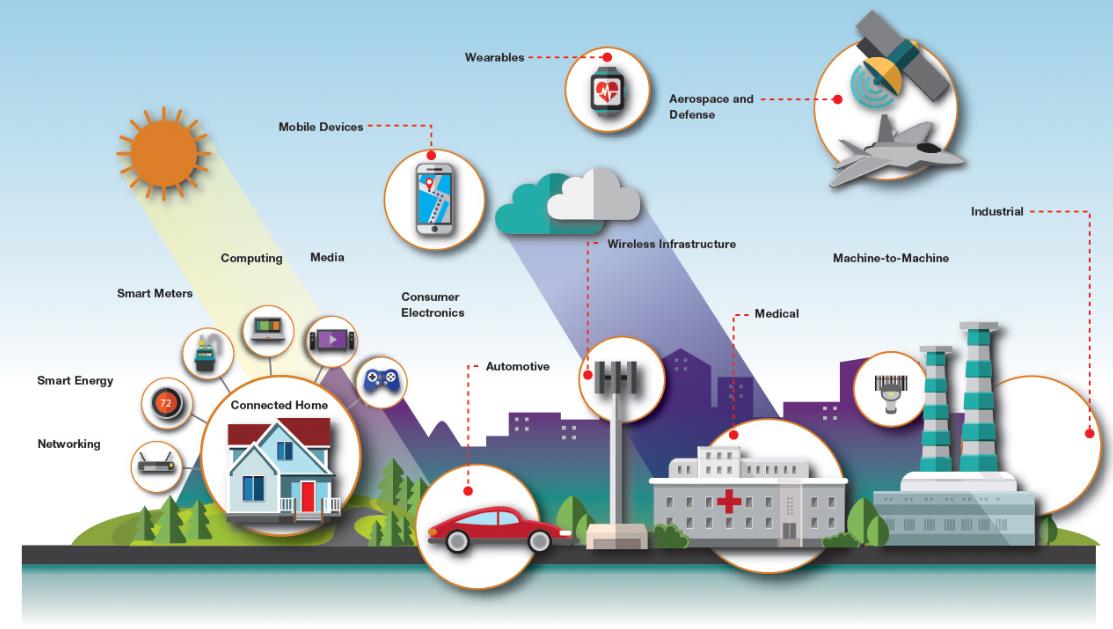
Image Source: Skyworks
Summary:
· The Internet of Things has been called ‘the next Industrial Revolution,’ and the revolution is already well underway.
· Explosive growth can be expected in the number of devices connected to the Internet in coming years, and the data extracted from such devices will enable businesses to make significant value creating improvements to operations.
· The proliferation of the Internet of Things will take a combined effort from the end user of the technology to smart device manufacturers to software providers to networks.
· The newsletter portfolios have significant exposure to early large-cap adopters of the IoT. We love the potential we see in some of our favorite names to capitalize on ‘the next Industrial Revolution.’
By Kris Rosemann
An ever-growing portion of our lives is dependent on access to the Internet, and the same can be said for businesses of all shapes and sizes. Devices other than typical computing devices (smartphones, tablets, PCs) are being manufactured with ‘smart’ capabilities, or the ability to connect and interact with other machines via the Internet. The connection of such devices is referred to as the Internet of Things (IoT), and it has been dubbed ‘the next Industrial Revolution.’
Estimates have placed the current number of devices connected to the internet at ~23 billion, but that number is expected to skyrocket to more than 50 billion by 2020. The usefulness of IoT technology is seemingly endless; it can enhance consumers’ lives, business practices, and even regulatory oversight. Examples of the influence of regulatory oversight include the Energy Act (2007), which increased efforts to monitor efficient energy consumption, and the Drug Supply Chain Act, which aims to prevent the counterfeiting of drugs via the use of rigid digital inventory processes.
Businesses are expected to be the largest users of the IoT–relative to consumers and government entities–due to the presence of material value creating opportunities such as lower operating costs and increased productivity as well as efficiency improvements in expansion into new markets and new product development. As a result, investors are most excited about the commercial applications of the IoT. Beneficiaries of early IoT technology include those involved in manufacturing, infrastructure, oil and gas, utilities, transportation, retail, defense, logistics, and construction (via connected homes and smart buildings).
Broad-based value-creating improvements can be expected from companies that adopt IoT technology in their business practices, but as more and more firms adopt the new technology, it will cease to be the competitive advantage it gives some early adopters. That is not to say that material productivity improvements are not to be had by adoption of the IoT, but rather the value creation opportunity relative to competitors will diminish as we move forward into ‘the next Industrial Revolution.’ Employing IoT technology, and the realization of the benefits of the technology, will eventually become the new norm and necessary to remaining competitive.
Let’s think back to the original Industrial Revolution. The first cotton farmers to use Eli Whitney’s cotton gin in the late 18th century had a material competitive advantage over those still using out-of-date manual methods. As more and more cotton farmers began to use the cotton gin, that competitive advantage eroded, but the efficiency improvements relative to manual methods previously employed remained for each incremental farmer that was able to migrate to the new technology. Those creating the new technology, the cotton gin in this instance, were the biggest beneficiaries of the revolutionary technology, though the industry it served experienced a positive change in its fundamental operating structure, as they held the key to robust operational improvements, and ultimately, the key to remaining competitive.
The big winners in the IoT movement stand to be those involved in the creation, maintenance and supply of IoT technology. Those implementing IoT into business processes, which can apply to almost any business model that uses physical assets to create a product or data analysis to improve productivity, will realize a similar change in business fundamentals as the cotton farmers in our above example. IoT technology includes not only the manufacturing of IoT capable hardware but also software platforms, networks and the network infrastructure that makes the connection of IoT devices possible. The companies that are able to create new, original competitive advantages out of the IoT revolution will be the biggest beneficiaries.
Massive IoT platforms, which serve as the connector between IoT devices and the networks with which they interact, will be necessary for the immense shift to interconnected products that will be seen in coming years. There are currently hundreds of IoT platforms on the market today, but some of the heavy hitters include Amazon Web Services (AMZN), Microsoft (MSFT) Azure, Cisco (CSCO) IoT Cloud Connect, Salesforce (CRM) IoT Cloud, and Oracle (ORCL) Integrated Cloud. General Electric (GE) Predix and Honeywell (HON) Uniformance Suite are the two biggest names in the Industrial Internet of Things platform space.
A breakdown and analysis of each of these platforms goes beyond the scope of this article, and may be a fruitless endeavor at this point in time as each platform has positives and negatives for more specified applications and developments. At this stage in the IoT lifecycle, firms are still working to find their respective ways, and something similar to a land grab looks to be taking place as early movers work to gain exposure for their platforms. Partnerships may be the most important measure of success for the time being, as the long-term landscape of the developing market remains very much up in the air. Cross-functional collaboration abilities will be key to success, and we are of the opinion that this will continue to be a very competitive market for an extended period of time.
Much to the appeal of our newsletter portfolios, GE and Microsoft announced a partnership in July 2016 in which they will make GE’s Predix software platform available on Microsoft’s cloud-based Azure. Predix had already been helping industrial customers transform their businesses, but the partnership significantly enhanced the capabilities available, as Azure has one of the largest cloud-footprints in the world, a major advantage.
Big data is what makes the IoT so attractive to businesses, and what will make the aforementioned platform providers so vital as those platforms are what enable the passing of the data to and from IoT devices. The ability to read and react to colossal amounts of real-time data taken directly from manufacturing processes will drive more informed operating decisions, making the adoption of such technology a necessity to compete effectively in the next generation of business. In the case of manufacturing, the above mentioned IoT platforms do not make the connected devices or machines more efficient themselves, though some smart devices are able to be controlled remotely. What they do is enable the connected machines to reap massive amounts of data, which is then analyzed, stored and used to make more informed operating decisions. As technology advances, machines will be increasingly able to make these decisions, or adjustments, themselves in what is referred to as machine learning.
Connectivity will also be a major factor as the Internet of Things proliferates. Local Internet networks are appropriate for many current applications of IoT technology, but mobile or isolated devices require a cellular network to remain connected. Verizon (VZ) and AT&T (T) are expected to be the two key players in this area in the US, as they have already been active in developing and marketing the IoT applications of their respective networks. Verizon may be able to differentiate itself from even AT&T thanks to the anticipated launch of its 5G network, which is said to be able to provide speeds at multiples of current 4G services, in coming years. Verizon expects its 5G network will be able to, “provide an end-to-end ecosystem to enable a fully mobile and connected society.” The firm has even developed its own simplified IoT platform, called ThingSpace.
Chip makers are also expected to benefit from the evolving demand profile of the IoT. In the past, modifications to relatively similar chip designs were possible to continue evolving and improving the various iterations of PCs and smartphones that have made up the majority of the world’s connected devices, but with connected device applications ranging from industrial to home connectivity to aerospace and defense, chip configurations can be expected to continue to become much more diverse than in years past. This should maintain and enhance the ever-evolving nature of the semiconductor markets, as participants continually work to out-innovate the competition in a growing range of applications. Qualcomm (QCOM) and newsletter portfolios holding Intel (INTC) have made aggressive moves to gain exposure to a broader range of applications via the acquisition, or acquisition agreement, of NXP Semiconductor (NXPI) and Altera, respectively. We like what the Altera purchase did for Intel, “Why Intel Wants Altera,” and we expect the firm to continue reaping the benefits well into ‘the next Industrial Revolution.’
There is a wide variety of small and mid-cap stocks jockeying for position in various specialized avenues within the IoT. However, the risk associated with small tech companies is enormous, in our opinion, and generally loses its luster in the context of the technology sector specifically. For one, the growth potential of larger, innovative tech companies is still very reasonable–particularly in the context of a revolutionary development such as the IoT–offering much more amenable risk-adjusted considerations than riskier smaller entities that may not make it through the next downturn. However, those seeking exposure to smaller IoT focused companies may consider the Global X Internet of Things Thematic ETF (SNSR). The ETF provides investors with meaningful exposure to more speculative IoT plays, but also maintains exposure to a few large cap names, including Intel, Qualcomm, Cisco, IBM (IBM), and Honeywell.
We believe there is a sufficient amount of growth to be had via exposure to some of the less-risky, large cap players in the space, especially since we are still in the early stages of ‘the next Industrial Revolution.’ The progress Dividend Growth Newsletter portfolio holding Microsoft has made in its business transformation and the momentum in Azure has been impressive as of late, “Cloud Lifting Microsoft Shares Toward All-Time Highs.” Newsletter portfolios holding Cisco solidified itself as a major player in the shift towards cloud computing and the Internet of Things via its early 2016 acquisition of cloud-based IoT service platform provider Jasper. The potential of newsletter portfolios holding GE’s IoT offerings is tremendous from both an operational and financial standpoint, “GE Hikes Payout; Digital Transformation to Benefit Income Investors,” and we continue to be fans of Intel’s decision to scoop up Altera and the opportunities the acquisition should provide.
GE may very well become the poster-child of the IoT revolution, and we think it may have the most exposure to the entire spectrum of the IoT, both of which we see as first-mover advantages. Not only is it a manufacturer, and as such will it be able to employ IoT technology in its manufacturing processes, but it also has a massive software platform in Predix that is already experiencing positive momentum in its adoption, serving the healthcare, transportation and energy sectors. The firm recently signed one of its largest software agreements to date with Exelon (EXC), in which it will deploy Predix across a plethora of the firm’s power plants, working to materially improve operating efficiency. GE’s partnership with Microsoft should not be taken lightly.
While we continue to observe the massive shift towards an interconnected world, we do not see a need for meaningful adjustments to either newsletter portfolio at this point in time. We believe we have adequate exposure to capture various parts of the IoT pie, with IoT platform exposure coming in the form of Microsoft and Cisco, industrial IoT exposure–as well as more platform exposure–coming via GE, and exposure to chip suppliers in Intel. We even have exposure to the consumer market of the IoT via Apple (AAPL), whose HomeKit platform allows users to control all of their connected devices (home security, lights, thermostats, doors, etc.) from one app on a mobile device. Apple is finding ways to extend its ecosystem of apps even further into the lives of consumers, which is great news for the long-term performance of both of our newsletter portfolios.